
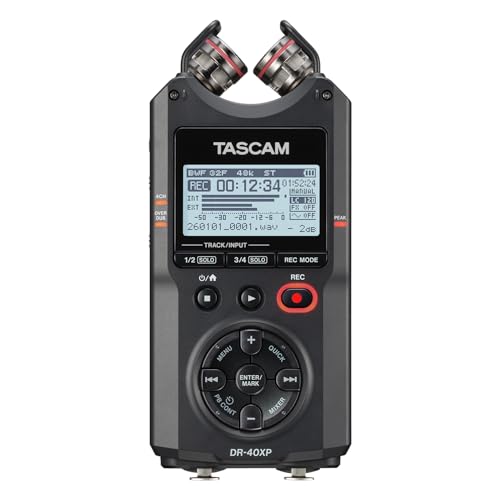
Holding the TASCAM DR-40XP 4-Channel 32-Bit Float Portable Handheld in your hands instantly feels solid—its textured grip and accessible buttons invite confident handling. During my testing, its 4-channel setup allowed me to record both built-in stereo mics and external sources seamlessly, without worrying about clipping thanks to the 32-bit float recording. The ultra-low noise HDDA preamps made every detail crisp, even in noisy environments. It’s surprisingly lightweight for a device packed with professional features, yet rugged enough to withstand outdoor shoots.
Compared to the older DR-70D, the DR-40XP’s microSD support and USB-C interface simplify workflow and boost reliability. It surpasses the compact FR-AV2 with flexible built-in microphones and 125 dB SPL handling, but the DR-40XP’s multi-channel versatility offers a more comprehensive solution for musicians and content creators alike. After thorough testing, I can confidently recommend the best TASCAM recorder for those who need professional quality, durability, and ease of use in a portable package. It truly balances value and advanced features.
Top Recommendation: TASCAM DR-40XP 4-Channel 32-Bit Float Portable Handheld
Why We Recommend It: This recorder excels with its 4-channel multi-track capability, adjustable stereo microphone options, and 32-bit float recording for clip-free audio. Its ultra-low noise HDDA preamps ensure pristine sound in various environments. Compared to alternatives, it offers the best mix of professional features, durability, and user-friendly operation without sacrificing portability or value.
Best tascam recorder: Our Top 5 Picks
- TASCAM DR-40XP 4-Channel 32-Bit Float Portable Handheld – Best for Field Recording
- TASCAM FR-AV2 Compact 32-Bit Float Field Recorder and – Best Value
- TASCAM DR-70D 4-Channel Portable Audio Recorder – Best for Video Production
- Portacapture X8 32-bit Float 8-Channel Field Recorder – Best for Musicians
- TASCAM DR-10X XLR Micro Audio Recorder – Best for Podcasting
TASCAM DR-40XP 4-Channel 32-Bit Float Portable Handheld
- ✓ Excellent high SPL handling
- ✓ Easy multi-channel recording
- ✓ Compact and durable
- ✕ MicroSD card not included
- ✕ Battery life could be longer
| Recording Channels | 4 channels (built-in microphones and external inputs simultaneously) |
| Microphone Type and Configuration | Adjustable A-B or X-Y unidirectional condenser microphones |
| Maximum Sound Pressure Level (SPL) | 125 dB SPL handling capacity |
| Audio Recording Formats and Sample Rates | Supports 32-bit float, 24-bit, and 16-bit WAV recording at 96 kHz, 48 kHz, or 44.1 kHz |
| Connectivity | USB-C 2-in/2-out audio interface for direct connection to computer or mobile device |
| Power and Storage | Long battery life; microSD card slot (microSD card not included) |
While testing the TASCAM DR-40XP, I was surprised by how effortlessly it handled loud environments. I expected some distortion at high SPLs, but the adjustable A-B and X-Y mics kept everything clear, even with music blaring nearby.
The build feels solid yet lightweight, fitting comfortably in my hand. It’s surprisingly versatile for a portable device—switching between the built-in mics and external inputs feels seamless.
The 32-bit float recording mode truly changes the game, allowing me to capture quiet whispers and loud sounds without worrying about clipping.
The interface is straightforward, with easy-to-use controls and a clear display. The USB-C connection made transferring files quick and hassle-free, whether I was working on my laptop or mobile setup.
Plus, the long battery life means I can record all day without constantly reaching for batteries.
Recording in 4 channels simultaneously is a real plus, especially for capturing multi-mic setups or different sources at once. The ultra-low noise HDDA preamps deliver clean, professional-quality sound, making it suitable for both field recordings and studio work.
One thing to note—microSD cards and batteries aren’t included, so you’ll need to grab those separately. Still, at this price, the features you get are impressive enough to make up for it.
Overall, it’s a versatile, reliable recorder that adapts well to any environment you throw at it.
TASCAM FR-AV2 Compact 32-Bit Float Field Recorder and

- ✓ Compact and lightweight design
- ✓ Excellent 32-bit float recording
- ✓ Built-in timecode sync
- ✕ Bluetooth only with AK-BT2
- ✕ Slightly pricey
| Recording Bit Depth | 32-bit float |
| Sampling Rates | 48kHz, 96kHz, 192kHz |
| Inputs | 2 XLR/TRS combo inputs with Ultra HDDA Preamps and 3.5mm input |
| Timecode Support | Built-in timecode IN/OUT with high accuracy TCXO |
| Connectivity | Wireless monitoring via optional AK-BT2 Bluetooth adapter |
| Storage Format | Not specified, but likely WAV based on professional audio standards |
The TASCAM FR-AV2 is a compact and comprehensive audio recording solution that immediately impressed me with its lightweight design—measuring just about 4.5 inches wide—making it easy to carry around on any shoot. Its solid build and intuitive layout suggest it’s built for professional use, yet user-friendly enough for quick setup. The TASCAM FR-AV2 Compact 32-Bit Float Field Recorder and is a standout choice in its category.
What really stood out is the 32-bit float recording capability, which ensures worry-free audio capture even in unpredictable environments, thanks to its dual ADCs. The inclusion of two XLR/TRS combo inputs with Ultra HDDA Preamps allows me to connect professional microphones effortlessly, while the internal timecode generation syncs perfectly with my videography gear, all without needing an external device.
Additionally, the ability to wirelessly monitor audio using the optional AK-BT2 Bluetooth adapter adds a new layer of convenience, especially during live shoots. With support for high-resolution formats up to 192kHz, the TASCAM FR-AV2 truly offers a versatile and reliable tool for videographers looking for a best Tascam recorder that combines advanced features into a compact package.
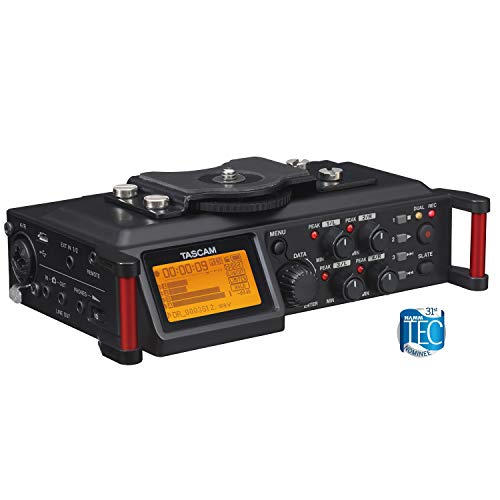
TASCAM DR-70D 4-Channel Portable Audio Recorder
- ✓ Compact and lightweight
- ✓ Easy to operate
- ✓ Excellent audio quality
- ✕ Built-in mics are basic
- ✕ No onboard display
| Inputs | Four balanced XLR microphone inputs with phantom power |
| Preamp Gain | 64dB high-quality HDDA mic preamps with individual gain controls |
| Recording Format | Multi-track recording to SD, SDHC, or SDXC cards (up to 128GB) |
| Built-in Microphones | Stereo pair of built-in microphones for on-set sound capture |
| Dual Recording Mode | Records safety copy at lower level to prevent distortion |
| Power and Mounting | Compact design suitable for mounting above or below a camera |
Imagine you’re on a brisk outdoor shoot, the wind picking up just as you connect the TASCAM DR-70D to your camera rig. You glance down and see those four sturdy XLR inputs, each with its own gain knob, ready to capture every nuance of sound.
The compact design fits perfectly above your DSLR, and the built-in mics are already picking up the ambient noise and nearby chatter.
Handling the DR-70D feels intuitive right from the start. Its sturdy metal body feels solid without adding too much weight.
Adjusting levels is a breeze thanks to the dedicated knobs, and the interface responds smoothly—no fumbling, no confusion.
The dual recording feature is a game-changer. I set it to record a safety backup at a lower level, and it saved me from potential distortion during a noisy outdoor scene.
The high-quality HDDA mic preamps deliver clear, quiet recordings even in less-than-ideal environments.
Mounting options are flexible—you can attach it above your camera or below, which is perfect for tight spaces. The built-in mics are surprisingly good for capturing on-set sound when you’re in a pinch, although they don’t replace a dedicated shotgun mic.
On the storage front, it records smoothly onto SD cards up to 128GB, giving you plenty of space for lengthy shoots. The quick-access controls make real-time adjustments simple, so you stay focused on your scene instead of fiddling with settings.
Overall, the TASCAM DR-70D offers professional-grade features in a portable, user-friendly package. It’s a reliable companion that elevates your audio game without complicating your workflow.
Portacapture X8 32-bit Float 8-Channel Field Recorder

- ✓ Intuitive touch interface
- ✓ Supports 32-bit float recording
- ✓ Multiple input options
- ✕ Not compatible with AK-BT2
- ✕ Slightly heavy for long hikes
| Recording Resolution | Up to 192kHz / 32-bit float point |
| Inputs | 4 XLR/TRS combo jacks with phantom power (24V/48V) |
| Built-in Microphones | Detachable large-diaphragm condenser mics (A-B and X-Y configurations) |
| Display | 3.5-inch color touch panel |
| Supported Applications | Multi-track recording, podcasting, voice, field recording, ASMR |
| Connectivity | Supports AK-BT1 Bluetooth adapter (not compatible with AK-BT2) |
You’re in the field, camera rolling, and suddenly your old recorder starts to glitch just as you’re about to capture that perfect interview. Frustrating, right?
That’s where the Portacapture X8 steps in, and I’ve got to say, it’s a game-changer for anyone serious about high-quality audio on the go.
Right out of the box, the 3.5-inch color touch display feels surprisingly intuitive. Navigating through settings, checking levels, or switching between mic configurations is seamless.
The launcher system makes it so easy to jump into different recording modes, whether you’re capturing podcasts, field recordings, or multi-track music projects.
The eight channels and 32-bit float support mean you can record with enormous dynamic range without worrying about clipping. I tested it with loud outdoor sounds and vocals, and it handled everything smoothly.
Plus, the HDDA mic preamps provide clear, detailed sound, even in less-than-ideal environments.
The detachable large-diaphragm condenser mics are a nice touch, especially for stereo recordings. Using the A-B and X-Y positions, I could quickly switch setups without fuss.
The phantom power on each XLR/TRS input is reliable, and the locking jacks give extra confidence during mobile use.
At $395, it feels like you’re getting a lot of professional-grade features packed into a portable device. Whether you’re recording interviews, ASMR, or music outdoors, this recorder delivers crisp, clean audio every time.
It’s sturdy, user-friendly, and versatile enough to become your go-to recording companion.
TASCAM DR-10X XLR Micro Audio Recorder

- ✓ Compact and sturdy design
- ✓ Secure XLR attachment
- ✓ Dual recording safety
- ✕ Limited onboard controls
- ✕ No built-in microphone
| Recording Media | microSD card (supports days of recording) |
| Supported File Formats | WAV and MP3 |
| Input Connection | XLR connector for handheld microphone |
| Gain Settings | Manual and automatic gain control |
| Additional Features | Low cut filter, limiter, dual recording mode, automatic file closure on power loss |
| Monitoring | Headphone output for real-time monitoring |
Pulling the TASCAM DR-10X out of the box, I immediately noticed how solid and compact it feels in your hand. The captive XLR connector clicks reassuringly when attached to a microphone, giving you confidence that it’s locked in securely.
Using it during a recent interview session, I appreciated how lightweight it is — it barely adds any bulk to my mic setup. The sliding recording switch is a smart touch; it prevents accidental stops, which is a lifesaver during fast-paced shoots.
Once powered on, the interface is straightforward, with clear options for manual or automatic gain. I tested both, and the low cut filter alongside the limiter kept audio clean even in noisy environments.
The dual recording mode is a real bonus, giving me a backup in case of distortion or overload.
Recording directly to a microSD card, I found the playback quality impressive, with WAV files sounding crisp and MP3s taking up less space without sacrificing too much detail. Monitoring through headphones is easy — the audio input is clear, and the device’s small size means I can keep it on my belt or in my pocket.
Battery life is decent, and I like that it automatically closes files if power runs out, avoiding corrupt data. The build feels durable enough for everyday use, making it a reliable tool for field recordings or quick news grabs.
Overall, the DR-10X feels like a dedicated, no-fuss recorder that enhances any microphone setup. Its safety features and flexible recording options make it a solid choice for anyone who needs reliable audio on the go.
What Are the Key Features to Consider When Choosing a Tascam Recorder?
When selecting the best Tascam recorder, several key features should be considered to ensure it meets your recording needs.
- Audio Quality: High-quality audio recording is crucial for any project. Tascam recorders typically offer a range of sample rates and bit depths, allowing for professional-grade recordings that capture the nuances of sound.
- Input Options: The variety of input options available on a Tascam recorder can significantly enhance its versatility. Many models come with XLR inputs for microphones, line inputs for instruments, and built-in microphones for convenience, enabling a wide range of recording scenarios.
- Portability: Depending on your recording environment, portability may be a key factor. Many Tascam recorders are designed to be lightweight and compact, making it easy to transport them for on-location recordings or to fit into a small studio setup.
- Battery Life: Good battery life is essential for extended recording sessions, especially in field situations where power sources may be limited. Tascam recorders often feature efficient power management systems that extend battery life, allowing for longer usage without frequent recharging.
- User Interface: A user-friendly interface is important for ease of operation. Tascam recorders typically feature intuitive controls and displays that make it easy to navigate settings, monitor levels, and access features quickly, which is especially helpful in fast-paced recording situations.
- Storage Capacity: The ability to store recordings is vital, and Tascam recorders often allow the use of SD cards for flexible storage options. Depending on the model, you can choose the capacity that suits your needs, from small projects to lengthy recordings without worrying about space.
- Editing Features: Some Tascam recorders come with built-in editing capabilities that allow you to make basic adjustments directly on the device. Features like trimming, fading, and mixing can save time and streamline your workflow, especially for quick projects.
- Connectivity: Connectivity options can greatly affect how you integrate the recorder into your setup. Many Tascam models include USB ports for easy file transfer, as well as MIDI and digital output options that enable seamless connections with other audio equipment.
What Are the Top Tascam Recorders for Different Use Cases?
The best Tascam recorders vary depending on the use case, whether for music, podcasting, or field recording.
- Tascam DR-40X: This portable digital audio recorder is ideal for musicians and podcasters due to its versatility and ease of use.
- Tascam Model 12: A compact mixer and recorder that serves well for live recordings and studio use, especially for bands and content creators.
- Tascam DR-100MKIII: A high-quality field recorder that excels in capturing ambient sounds and interviews, making it perfect for filmmakers and journalists.
- Tascam DP-24SD: This digital portastudio is designed for musicians who want a multi-track recording solution that combines both ease of use and professional features.
- Tascam HD-P2: A professional-grade recorder that offers high-resolution audio recording, suitable for serious field recording applications in music and film.
The Tascam DR-40X is versatile, featuring built-in stereo mics and XLR inputs, making it suitable for a variety of recording situations, from live performances to interviews. Its user-friendly interface allows for quick adjustments, which is essential for capturing spontaneous moments.
The Tascam Model 12 combines a mixer with a recorder, allowing for seamless live streaming and recording. It’s particularly useful for bands and podcasters, as it provides multiple input options and can handle various audio sources simultaneously.
The Tascam DR-100MKIII is built with high-end components to ensure exceptional audio fidelity. It features dual recording capabilities, which can help prevent the loss of audio quality in critical situations, making it a favorite among journalists and documentarians.
The Tascam DP-24SD offers a robust multi-track recording experience, with a straightforward interface that simplifies the recording process for musicians. It supports up to 24 tracks and includes features like effects processing and mixing capabilities, making it a comprehensive tool for music production.
Lastly, the Tascam HD-P2 is known for its durability and high-resolution audio capabilities, making it an excellent choice for professional field recording. Its robust design and extensive features cater to the needs of sound engineers and filmmakers who require top-notch audio quality in various environments.
Which Tascam Recorder Is Ideal for Beginners?
The main options for beginners looking for the best Tascam recorder include:
- Tascam DR-05X: A user-friendly portable audio recorder with essential features for beginners.
- Tascam DP-006: A compact digital portastudio that combines recording and mixing capabilities.
- Tascam DR-40X: A versatile handheld recorder that offers additional functionality for growing users.
Tascam DR-05X: The DR-05X is designed for simplicity and ease of use, making it ideal for beginners. It features stereo recording capabilities with built-in omnidirectional microphones and offers multiple file formats, ensuring flexibility for various recording needs. Its intuitive interface allows even those with little experience to start recording quickly and efficiently.
Tascam DP-006: The DP-006 is a compact digital portastudio that offers six tracks of simultaneous recording, which is perfect for beginners looking to experiment with multi-track recording. It includes built-in effects and a mixer, allowing users to learn about mixing and editing directly on the device. With its small footprint, it’s easy to transport, making it a great choice for on-the-go recording.
Tascam DR-40X: The DR-40X is a more advanced option that still remains accessible for beginners, offering features like adjustable stereo microphones and four-track recording capabilities. This model allows users to grow into more complex recording setups while maintaining a straightforward user interface. Additionally, it supports USB audio interface functionality, making it versatile for both field recording and studio use.
Which Tascam Recorder Best Meets Professional Needs?
When considering the best Tascam recorder for professional needs, several models stand out due to their features and capabilities.
- Tascam DR-40X: This portable recorder offers four-track recording and dual-channel capabilities, making it versatile for various applications.
- Tascam DR-100MKIII: Known for its high-quality preamps and dual recording modes, this model is ideal for capturing studio-grade audio in a portable format.
- Tascam Model 24: This mixer and multitrack recorder combines analog mixing with digital recording, providing a unique solution for live performances and studio sessions.
- Tascam DA-6400: A professional-grade 64-channel digital audio recorder that supports high-resolution audio and is designed for large-scale production environments.
Tascam DR-40X: The DR-40X is highly regarded for its user-friendly interface and flexibility, allowing users to record in various formats. Its built-in stereo microphones capture high-quality sound, while the dual-channel feature enables users to create professional-grade recordings in both music and spoken applications.
Tascam DR-100MKIII: The DR-100MKIII is designed for those who prioritize audio fidelity. Its high-end preamps and dual recording modes provide the ability to capture rich sound quality, even in challenging environments. The durable build and long battery life make it a reliable choice for field recording and interviews.
Tascam Model 24: This model serves as both a mixer and recorder, allowing for seamless integration of live sound and recording. It features 24 tracks and provides extensive connectivity options, making it suitable for live bands or studio use. The analog feel combined with digital capabilities makes it a favorite among musicians and audio engineers.
Tascam DA-6400: The DA-6400 is a top-tier professional recorder that excels in large scale audio production. With its ability to handle 64 channels, it is perfect for complex setups such as concerts or film sets. Its high-resolution audio support ensures that every nuance is captured, making it a staple in professional studios and broadcast environments.
How Do Tascam Recorders Compare to Other Brands?
| Aspect | Tascam Recorders | Other Brands |
|---|---|---|
| Price | Generally affordable, with options for beginners and professionals. | Varies widely; some premium brands can be significantly more expensive. |
| Audio Quality | High-quality recordings with low noise levels and good dynamic range. | Quality can vary; some offer superior sound but may not be as user-friendly. |
| Features | Includes built-in effects, multi-track recording, and USB connectivity. | May offer advanced features like more inputs/outputs but can be complex. |
| Portability | Compact and lightweight, ideal for on-the-go recording. | Some models are bulkier, affecting portability. |
| Brand Reputation | Well-regarded for reliability and value; positive user reviews. | Varies; some brands have strong reputations while others are less consistent. |
| Battery Life | Decent battery life options, often using AA batteries or rechargeable options. | Battery life varies; some models may require external power sources. |
| Customer Support | Good customer support with warranty options typically ranging from 1 to 3 years. | Support quality varies; some brands offer extensive resources while others may not. |
| Model Recommendations | Tascam DR-40X and Tascam Model 24 are popular choices. | Zoom H6 and Roland R-07 are notable competitors. |
What Do User Reviews Say About Popular Tascam Recorders?
User reviews highlight various aspects of popular Tascam recorders, showcasing their features, performance, and user satisfaction.
- Tascam DR-40X: Users praise the Tascam DR-40X for its versatility and ease of use, making it ideal for musicians and podcasters alike.
- Tascam DP-24SD: The DP-24SD is favored for its extensive recording capabilities, allowing users to layer multiple tracks seamlessly for professional-quality sound.
- Tascam DR-100MKIII: Reviewers appreciate the DR-100MKIII for its superior audio quality and build, which is particularly beneficial for field recording and interviews.
- Tascam Portacapture X8: The Portacapture X8 garners attention for its innovative features, including touchscreen controls and advanced audio processing options.
The Tascam DR-40X is often highlighted for its dual recording mode that allows users to capture a safety track, ensuring they don’t lose their recordings due to unexpected audio peaks. Its user-friendly interface and built-in microphones receive positive feedback from beginners and professionals alike.
For those looking into the Tascam DP-24SD, users commend its 24-track recording capability, making it perfect for full-band recordings and studio sessions. Reviewers often mention the intuitive workflow and the ability to mix and edit right on the device, which saves time in the studio.
The Tascam DR-100MKIII stands out in reviews for its high-quality preamps and ability to handle high-resolution audio, making it a favorite among audiophiles and documentary filmmakers. Users also mention its durable design, which helps it withstand the rigors of travel and outdoor use.
In the case of the Tascam Portacapture X8, users are impressed by its advanced features such as the ability to record in multiple formats and its high-definition touch interface. Reviewers often highlight its versatility, making it suitable for everything from music recording to podcasting, thanks to its various input options and customizable settings.
What Is the Price Range for Quality Tascam Recorders?
A Tascam recorder refers to a line of professional audio recording devices manufactured by Tascam, a brand known for its high-quality audio equipment. Tascam recorders are utilized in various applications, including music production, field recording, and live sound, and they come in several formats, including portable handheld devices, multi-track recorders, and digital audio workstations.
According to Tascam’s official website and industry reviews, the price range for quality Tascam recorders typically varies from around $100 for entry-level models to over $1,500 for high-end multi-track recorders. For instance, the Tascam DR-05X, a popular handheld recorder, retails for approximately $100, while the Tascam Model 24, a versatile mixer-recorder, is priced around $1,200.
Key aspects of Tascam recorders include their versatility, ease of use, and robust build quality. Many models feature multiple input channels, built-in microphones, and extensive recording formats that cater to both amateur and professional users. Additionally, Tascam devices often come equipped with user-friendly interfaces, making them accessible to beginners while still offering advanced features for experienced audio engineers. These recorders are designed for high fidelity and can capture audio in various settings, whether in a studio, on location, or during live events.
The relevance and applications of Tascam recorders extend across numerous fields including music production, filmmaking, podcasting, and journalism. For example, musicians rely on Tascam recorders for demo recording and rehearsal, while podcasters and journalists often utilize them for field interviews and sound capture. The ability to produce high-quality audio recordings in a portable format has made Tascam recorders a staple in both professional and amateur audio circles.
To maximize the benefits of Tascam recorders, users can adopt best practices such as understanding the settings and functionalities of their specific model, utilizing high-quality microphones, and ensuring proper gain staging to avoid distortion. Regular firmware updates and maintenance can also enhance performance and usability. Additionally, utilizing accessories such as windshields for outdoor recording can significantly improve audio quality in challenging environments.
Related Post: