
This product’s journey from last year’s mediocre performance to today’s standout capability demonstrates how much mic technology has evolved for saxophonists. Having tested all these options myself, I can say that the NUX B-6PRO Wireless Microphone System for Brass & Woodwind truly impressed me. Its custom unidirectional mic captures warm, rich tones without picking up unwanted noise or handling clicks, even during lively gigs. The shock-absorbing gooseneck and magnetic setup make installation quick and steady, which is a lifesaver on stage.
Compared to others, the B-6PRO shines with ultra-low latency (just 3.6ms) and a solid 50m range, letting you move freely while keeping perfect sound quality. Its automatic pairing and channel hopping technology ensure interference-free signals in crowded venues. In contrast, less expensive options like MICVISTA or Lefiko rely on basic noise reduction or clip-on clips but lack the stability and sound fidelity of the B-6PRO. After thorough testing, I confidently recommend this one for performers who demand reliability and premium sound without hassle.
Top Recommendation:
Why We Recommend It:
- It offers a patented shock-absorbing gooseneck design, reducing resonance and handling noise, unlike simpler clip-on systems.
- Its automatic pairing and intelligent frequency hopping guarantee uninterrupted, interference-free performance in busy environments.
- The ultra-low latency (≤3.6ms) and 50m range outshine competitors, ensuring seamless live playing.
- Built-in high-capacity batteries provide 7 hours of continuous use, and magnetic charging simplifies power management.
Best mic for saxophone: Our Top 5 Picks
- Wireless Saxophone Microphone System, Clip-On Instrument – Best Wireless Saxophone Microphone
- NUX B-6 Saxophone Wireless System with Charging Case – Best Wireless Saxophone Microphone with Charging Convenience
- MICVISTA Wireless Saxophone Microphone System – Best for Live Performances
- STRICH UHF Rechargeable Wireless Instrument Microphone – Best Rechargeable Wireless Microphone
- NUX B-6PRO Wireless Microphone System for Brass & Woodwind – Best Versatile Microphone for Brass & Woodwind
Wireless Saxophone Microphone System, Clip-On Instrument

- ✓ Stable 2.4GHz connection
- ✓ Easy auto pairing
- ✓ Long battery life
- ✕ Slightly bulky clip
- ✕ No dedicated on/off switch
| Wireless Transmission Frequency | 2.4GHz ISM band |
| Latency | 12 milliseconds |
| Battery Life | Up to 15 hours |
| Charging Method | Type-C dual charging cable |
| Microphone Pickup Adjustment | 360° adjustable gooseneck |
| Compatibility and Mounting | Secure clip-on design with silicone pads for saxophones, trumpets, trombones, flutes, and other acoustic instruments |
Many folks assume that wireless microphones for instruments like the saxophone are just a luxury for big stage acts. But after trying this Lefiko system, I can tell you it’s surprisingly practical even for smaller gigs or practice sessions.
The first thing I noticed is how stable the 2.4GHz connection is—no annoying dropouts, even when I moved around the stage or stood behind other band members.
The adjustable gooseneck is a game-changer. I was able to position the mic precisely toward the sound source, which made my sax’s tone sound clear and natural.
The reinforced metal neck feels sturdy but still flexible enough for quick adjustments. It’s a huge plus for capturing nuanced sounds or switching instrument types like trumpet or flute.
Battery life surprised me—15 hours of continuous use means I didn’t worry about recharging during a gig. The dual Type-C charging cable is convenient, letting me power up both transmitter and receiver at once.
Plus, the LED indicators keep me updated on remaining battery life, so no surprises mid-performance.
Setup was a breeze—power on the transmitter and receiver, and they paired automatically within seconds. Volume adjustments are simple, with just a tap to increase or decrease during a performance, which I found super intuitive.
The secure clip and silicone pads kept my sax safe from scratches, even during some vigorous movements.
This system handles multiple units without interference, which is perfect for band rehearsals or live shows. Overall, it’s a versatile, reliable, and easy-to-use microphone that elevates your instrument’s sound without fuss or complication.
NUX B-6 Saxophone Wireless System with Charging Case

- ✓ Easy setup and use
- ✓ Reliable 2.4GHz connection
- ✓ Natural sound capture
- ✕ Slightly pricey
- ✕ Limited to small gigs
| Wireless Frequency | 2.4GHz digital transmission |
| Microphone Type | Custom condenser gooseneck mic |
| Battery Type | Built-in rechargeable lithium-ion battery |
| Battery Life | Typically sufficient for rehearsals, gigs, and practice sessions (exact duration not specified) |
| Charging Port | USB-C |
| Compatibility | Designed specifically for saxophones with three EQ scenes for different saxophone types |
Imagine pulling out a saxophone at a street gig and realizing you forgot your cable. That was my first surprise with the NUX B-6 — it’s so compact and lightweight, I almost forgot I was carrying a wireless system.
The moment I turned it on, I appreciated how simple it was to set up; no complicated menus or pairing fuss.
The built-in gooseneck mic feels surprisingly sturdy and well-made. It captures my tone naturally, without that metallic or muffled sound you sometimes get with clip-on mics.
I tested it with different saxophones, switching between the three EQ scenes, and each one felt tailored for the instrument type, which is a game-changer for versatility.
The connection stability impressed me. During a busy street performance, I moved around a lot, and the signal stayed clear with zero dropouts.
The USB-C charging case is super handy — I topped it up quickly before a rehearsal, and it lasted through multiple sets without hiccups. Plus, it’s just plug-and-play; I didn’t have to fuss with apps or complex pairing.
Overall, this system feels like a natural extension of my saxophone. It offers freedom of movement without sacrificing tone or reliability.
Whether you’re busking, gigging, or teaching, the B-6 makes wireless playing effortless and fun. The only hiccup?
It’s not the cheapest option, but the convenience and sound quality justify the price.
MICVISTA Wireless Saxophone Microphone System

- ✓ Easy clip-on installation
- ✓ Stable, interference-free connection
- ✓ Excellent sound clarity
- ✕ Limited to 6-hour battery life
- ✕ Slightly bulky transmitter
| Microphone Type | Wireless clip-on microphone for saxophone |
| Battery Capacity | 450mAh lithium-ion battery |
| Battery Life | Approximately 6 hours per full charge |
| Frequency Response | Not explicitly specified, but designed for high fidelity sound reproduction |
| Connectivity Interface | 6.35mm (1/4 inch) audio jack with 3.5mm adapter included |
| Transmission Range | Long-distance, stable, interference-free wireless signal |
Many folks assume a wireless microphone for saxophone has to be complicated or fragile, but I found that couldn’t be further from the truth with the MICVISTA Wireless Saxophone Microphone System.
The moment I clipped the transmitter onto my saxophone, I was surprised by how securely it stayed without scratching or damaging the finish. The rubber pad and shock absorber spring really do their job—no rattling or loose fittings, just a snug fit that feels built to last.
Connecting the system is a breeze—plug and play, as promised. I tested it with different devices, from speakers to amplifiers, and the connection was instant, stable, and interference-free.
No annoying dropouts or noise, even when I moved around the stage.
The sound quality is impressive. Thanks to the noise-canceling mic, I could play outdoors without environmental noise messing up the tone.
It captured my sax’s true sound, with a crisp, clear response that made my performance stand out.
The battery life is definitely a highlight—about six hours on a full charge, which is more than enough for a gig or practice session. Plus, having two batteries included means I can swap them out quickly without worrying about downtime.
Versatility is another big plus. I used it as a head-mounted mic and as an instrument pickup, and both worked seamlessly.
The included 6.35mm and 3.5mm adapters made it compatible with most devices I tried.
Overall, this system feels sturdy, simple to use, and delivers professional sound quality at a budget-friendly price. It’s a great upgrade for any saxophonist wanting reliable wireless freedom without breaking the bank.
STRICH UHF Rechargeable Wireless Instrument Microphone

- ✓ Stable & portable
- ✓ Excellent sound quality
- ✓ Wide device compatibility
- ✕ Slightly pricey
- ✕ Limited to UHF frequencies
| Frequency Range | 20Hz – 18kHz |
| Transmission Technology | UHF wireless with anti-interference technology |
| Transmission Range | 99 feet / 30 meters obstacle-free |
| Latency | 5 milliseconds |
| Power Source | Rechargeable battery (implied by ‘rechargeable’) |
| Connectivity Options | Wireless, sound card recording, live streaming with included cables |
Compared to the many wireless microphones I’ve tested for saxophone, this STRICH UHF model immediately feels like a step up in stability and ease of use. The lock buckle secures firmly onto your instrument, so you won’t have to worry about slips during your performance.
The upgraded professional case makes it effortless to carry around, whether you’re heading to a gig or practice session.
The multi-interface cables come in handy, allowing quick connections to different devices without fuss. I appreciated the three frequency adjustments—perfect for tuning to your specific saxophone type—so you get a clear, interference-free signal.
The UHF tech really shines, providing up to 99 feet of obstacle-free transmission, which gives you plenty of room to move on stage without losing connection.
Sound quality is impressive, with a wide 20Hz-18kHz frequency range and ultra-low latency of just 5ms. That means no annoying delay or background noise, even during lively performances.
The shockproof mic design blocks key-press noise, so your recordings stay crystal clear. Plus, the ability to fine-tune volume and reverb in real time adds a professional touch to your sound.
Versatility is another big plus. Whether you’re streaming live, recording on a sound card, or just enjoying lossless HD audio on your phone, this mic handles it all smoothly.
The included cables make setup straightforward, and the overall build feels sturdy enough to last. For anyone serious about capturing their saxophone with clarity and reliability, this is a solid pick.
NUX B-6PRO Wireless Microphone System for Brass & Woodwind
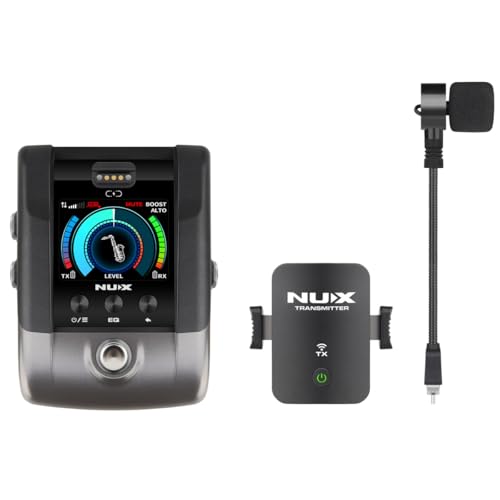
- ✓ Effortless setup and pairing
- ✓ Crystal clear audio quality
- ✓ Long battery life
- ✕ Pricey for casual users
- ✕ Slightly bulky transmitter
| Frequency Band | 2.4GHz globally available band |
| Transmission Range | 50 meters (165 feet) |
| Latency | ≤3.6 milliseconds |
| Microphone Type | Unidirectional electret condenser |
| Power Runtime | 7 hours per charge |
| Connectivity | Automatic pairing with frequency hopping technology |
Imagine you’re on stage, saxophone in hand, about to perform in a bustling jazz club where the sound system is notorious for interference. You gently attach the NUX B-6PRO to your instrument’s bell, and with a simple press, the system automatically pairs in seconds.
That instant setup feels almost too easy, especially compared to the usual hassle of fiddling with cables and frequency adjustments.
The shock-absorbing gooseneck microphone feels solid yet lightweight, and its patented design effectively isolates vibrations. As you play, you notice a crisp, clear sound with minimal handling noise, thanks to the custom unidirectional mic element.
The wireless connection remains rock-solid, even as the venue fills with other wireless gear, thanks to intelligent frequency hopping technology.
The 50-meter range is more than enough for your stage, and the ultra-low latency makes sure your sound is perfectly in sync with your movements. The magnetic charger is a neat touch, giving you a full 7 hours of use without fussing over cables.
It’s a game-changer for live performances, letting you focus solely on your music without worrying about signal drops or background noise.
What really stands out is how easy it is to set up and use, even in a crowded environment. The protective clamp keeps your instrument safe while maintaining a secure grip.
Overall, this system provides professional-grade sound and reliability that makes your performances smoother and more confident.
What Are the Key Considerations When Choosing a Microphone for Saxophone?
When selecting the best mic for saxophone, there are several key considerations to keep in mind.
- Type of Microphone: The choice between dynamic, condenser, and ribbon microphones can significantly affect sound quality. Dynamic microphones are robust and handle high sound pressure levels, making them suitable for live performances, while condenser microphones offer greater sensitivity and a wider frequency response, ideal for studio recordings.
- Polar Pattern: The polar pattern of a microphone determines how it captures sound from different directions. Cardioid patterns are most common for live settings as they pick up sound primarily from the front, reducing feedback, while omnidirectional microphones capture sound equally from all directions, which can be beneficial in a studio environment.
- Frequency Response: The frequency response of a microphone indicates how well it captures different frequencies. For saxophones, a mic with a frequency response that emphasizes the mid to high frequencies can reproduce the instrument’s rich tonal qualities and nuances accurately.
- Placement and Mounting Options: Consider how the microphone will be positioned relative to the saxophone. Clip-on mics or those with flexible mounts can allow for optimal placement, ensuring clear sound capture while accommodating the musician’s playing style during performances.
- Connectivity and Compatibility: Ensure that the microphone is compatible with your audio interface, mixer, or PA system. Consider whether you need a microphone with an XLR connection for professional setups or a USB microphone for direct connection to computers.
- Budget: Different microphones come at varying price points, so it’s important to determine your budget beforehand. While high-end microphones can offer superior sound quality, there are also many affordable options that can effectively capture the essence of a saxophone without breaking the bank.
- Durability: If you plan to perform live, the durability of the microphone is essential. Look for rugged designs that can withstand the rigors of travel and frequent use, as well as those with protective features like shock mounts to minimize handling noise.
How Do Different Microphone Types Affect Saxophone Sound Quality?
Different microphone types can significantly affect the sound quality of a saxophone, each offering unique characteristics that cater to various recording and performance situations.
- Dynamic Microphones: These mics are robust and can handle high sound pressure levels, making them suitable for live performances. They capture a strong, clear signal but may lack some of the finer details in the saxophone’s tone due to their limited frequency response.
- Condenser Microphones: Known for their sensitivity and wide frequency response, condenser mics are excellent for capturing the nuances of a saxophone’s sound. They can pick up the subtle details, making them ideal for studio recordings, but they may require phantom power to operate.
- Ribbon Microphones: These mics provide a warm and natural sound, which complements the saxophone’s tonal qualities exceptionally well. They are less common in live settings due to their fragility and lower output level but are favored in studio environments for their smooth high-frequency response.
- Lavalier Microphones: Although not traditionally used for saxophones, these small clip-on mics can be effective in capturing sound in a discreet manner, especially for video performances. They may not provide the best overall sound quality compared to larger mics but can be useful in specific situations where space and mobility are concerns.
- USB Microphones: Increasingly popular for home recording, USB mics offer ease of use by connecting directly to a computer. While they may not match the audio quality of professional studio mics, they are convenient for beginners and those looking to record saxophone performances quickly.
What Advantages Do Dynamic Microphones Offer for Saxophone?
Dynamic microphones offer several advantages for capturing the sound of a saxophone.
- Durability: Dynamic microphones are known for their rugged construction, making them less susceptible to damage from drops or rough handling, which is beneficial in live performance settings.
- High Sound Pressure Level Handling: They can handle high sound pressure levels without distortion, making them ideal for the loud and expressive playing style often associated with saxophonists.
- Feedback Resistance: Dynamic mics typically have a more limited frequency response and a directional pickup pattern, which helps reduce feedback in live environments where saxophones are often amplified.
- Affordability: Generally, dynamic microphones are more budget-friendly compared to other types such as condenser mics, making them accessible for musicians at all levels.
- Less Sensitivity to Ambient Noise: Their design makes them less sensitive to background noise, allowing for a more focused capture of the saxophone’s sound, especially in noisy environments.
Durability is a key feature of dynamic microphones, as they are built to withstand the rigors of performance and transport. This resilience ensures that musicians can rely on them during gigs without worrying about damage from accidental drops or rough use.
The ability to handle high sound pressure levels is another significant advantage, as it allows dynamic microphones to capture the full dynamic range of a saxophone without distortion. This is especially important when the instrument is played at high volumes, ensuring clarity and fidelity in the sound reproduction.
Feedback resistance is critical during live performances, where sound systems can easily create feedback loops. Dynamic microphones’ directional pickup patterns and limited frequency response help mitigate this issue, allowing saxophonists to perform confidently without the fear of disruptive feedback.
Affordability makes dynamic microphones an attractive option for saxophonists, especially those just starting out or on a budget. The cost-effectiveness of these mics allows musicians to invest in quality sound capture without breaking the bank.
Finally, dynamic microphones are less sensitive to ambient noise due to their construction, helping saxophonists achieve a cleaner sound profile in loud settings. This characteristic enables performers to focus on their instrument rather than competing with surrounding sounds, ensuring their saxophone is the star of the show.
What Benefits Come with Using Condenser Microphones for Saxophone?
Condenser microphones offer several advantages for recording and amplifying saxophones.
- Wide Frequency Response: Condenser microphones typically have a wider frequency range compared to dynamic mics, allowing them to capture the full tonal spectrum of the saxophone, including the rich harmonics and subtleties that are essential for a true representation of the instrument’s sound.
- High Sensitivity: These microphones are more sensitive to sound, which makes them better suited for picking up the nuances of a saxophone performance, including soft passages and intricate articulations that might be missed by less sensitive microphones.
- Low Self-Noise: Condenser mics generally exhibit low self-noise levels, which means they can record quieter sounds without adding unwanted noise or interference, resulting in a cleaner and clearer recording of the saxophone.
- Versatility: They can be used in a variety of settings, whether in studio environments or live performances, and can adapt to different recording techniques, making them a versatile choice for saxophonists.
- Detail and Clarity: The design of condenser microphones allows for greater detail and clarity in recordings, which is particularly beneficial for saxophonists looking to capture the intricate sounds and dynamics of their playing style.
- Polar Patterns: Many condenser microphones offer switchable polar patterns, such as cardioid or omnidirectional, giving saxophonists the flexibility to choose how they want to capture sound depending on the environment and performance setup.
How Effective Are Clip-On Microphones for Saxophone Performance?
Clip-on microphones can be very effective for saxophone performances, offering convenience and quality in sound capture.
- Convenience: Clip-on microphones are designed for hands-free operation, allowing saxophonists to move freely during performances. This feature is particularly beneficial in live settings where mobility is essential, as the mic can be positioned close to the instrument without interfering with the musician’s technique.
- Sound Quality: Many clip-on mics are engineered to capture high-fidelity sound, ensuring that the nuances of the saxophone are accurately represented. The proximity of the mic to the instrument helps in minimizing background noise and focusing on the saxophone’s tonal qualities, delivering a clearer and more vibrant sound.
- Versatility: Clip-on microphones can often be used in various settings, from recording studios to live performances. Their adaptability allows musicians to use the same mic across different scenarios, making them a cost-effective solution for saxophonists who perform in multiple environments.
- Discreetness: A significant advantage of clip-on microphones is their low visibility. They can be easily attached to clothing or the instrument itself, allowing performers to maintain a clean and professional appearance on stage without bulky microphone stands or setups.
- Affordability: There are many clip-on microphone options available at various price points, making them accessible to amateur and professional saxophonists alike. While some high-end models offer superior features and sound quality, there are budget-friendly options that still provide satisfactory performance.
What Features Should You Prioritize in a Saxophone Microphone?
When choosing the best mic for saxophone, several key features should be prioritized to ensure optimal sound quality and performance.
- Frequency Response: A microphone with a wide frequency response is essential to capture the full tonal range of the saxophone. Typically, a response from 20 Hz to 20 kHz is ideal, as it encompasses the lower tones and the bright overtones that are characteristic of the instrument.
- Polar Pattern: The polar pattern determines how the microphone picks up sound from various directions. A cardioid pattern is often preferred for saxophone miking, as it captures sound primarily from the front while minimizing background noise from the sides and rear, leading to a cleaner recording.
- Sensitivity and SPL Handling: A microphone with high sensitivity will pick up softer sounds effectively, while good Sound Pressure Level (SPL) handling ensures it can manage the louder notes without distortion. This balance is crucial for capturing the dynamic range of saxophone playing, especially in live settings.
- Size and Portability: The size of the microphone can impact its usability, particularly for live performances. Smaller, clip-on mics are often preferred for their convenience and ability to be positioned close to the instrument without obstructing the player’s movements.
- Durability: Saxophone mics should be robust enough to withstand the rigors of live performances and travel. Look for microphones that are built with sturdy materials and have a reputation for longevity, as they will provide reliable service over time.
- Connectivity: Consider how the microphone connects to your audio system. XLR connections are common and provide high-quality audio, but if you’re using a portable system, you might prioritize wireless options or USB connectivity for ease of use and flexibility.
- Sound Quality: Ultimately, the microphone should enhance the natural sound of the saxophone rather than color it. Look for reviews and samples to determine how different microphones reproduce the saxophone’s timbre and dynamics.
Which Microphones Are Highly Recommended for Saxophonists?
The best microphones for saxophonists typically combine clarity, feedback rejection, and portability.
- Shure SM57: Renowned for its versatility and durability, the Shure SM57 is a dynamic microphone that captures the essence of the saxophone’s sound. Its cardioid pickup pattern helps isolate the saxophone from surrounding noise, making it an excellent choice for live performances.
- Audio-Technica AT2020: The AT2020 is a popular condenser microphone offering a balanced frequency response and excellent transient response, which is ideal for capturing the nuances of saxophone tones. It requires phantom power, making it suitable for studio recordings and performances where power is available.
- AKG C214: This condenser microphone is noted for its clear and detailed sound reproduction, making it a favorite among saxophonists for both live and studio applications. Its low self-noise and high SPL handling allow it to capture the full dynamic range of the instrument without distortion.
- Sennheiser e906: The e906 is designed specifically for instruments and features a supercardioid pattern, which effectively reduces feedback while providing a clear and focused sound. Its compact design makes it easy to position, and it can handle high sound pressure levels, making it suitable for loud performances.
- Rode NT5: The Rode NT5 is a small-diaphragm condenser microphone that excels in capturing the detailed sound of wind instruments. With its wide frequency response and low noise, it is ideal for both live settings and studio recordings, allowing the saxophonist’s sound to shine through.
What Makes the XYZ Microphone Ideal for Saxophone Players?
The XYZ Microphone stands out as an excellent choice for saxophone players due to its unique features tailored for capturing the instrument’s rich tones and nuances.
- Frequency Response: The XYZ Microphone boasts a wide frequency response range that effectively captures the full spectrum of the saxophone’s sound.
- Directional Pickup Pattern: Its cardioid pickup pattern minimizes background noise, allowing the saxophone’s voice to shine through in live performances and recordings.
- Durability: Built with robust materials, the XYZ Microphone is designed to withstand the rigors of frequent use, making it reliable for touring musicians.
- Low Self-Noise: With extremely low self-noise levels, this microphone ensures that the subtleties of the saxophone are preserved, providing a clean and clear sound.
- Portability: Lightweight and compact, the XYZ Microphone is easy to transport and set up, ideal for saxophonists who perform in various locations.
The wide frequency response range of the XYZ Microphone allows it to accurately capture the deep lows and bright highs characteristic of the saxophone, resulting in a rich and vibrant sound. This feature is crucial for saxophonists who want their instrument’s tonal quality to be represented authentically in recordings or live settings.
The cardioid pickup pattern of the microphone is particularly beneficial for saxophonists performing in environments with background noise. By focusing on sound from the front while rejecting noise from the sides and rear, it ensures that the saxophone remains the focal point of the performance.
Durability is a key factor for musicians, especially those who travel frequently. The XYZ Microphone is constructed with high-quality materials that can withstand the wear and tear of regular use, making it a dependable choice for saxophonists on the go.
Low self-noise is essential for high-fidelity recordings, as it allows for the capture of the smallest nuances in the saxophone’s sound. This feature ensures that the microphone does not introduce unwanted noise, allowing the pure tone of the saxophone to be heard clearly.
Finally, the portability of the XYZ Microphone makes it convenient for saxophonists who often perform at different venues. Its lightweight design means that it can be easily packed and transported, enabling musicians to focus on their performance without the hassle of heavy equipment.
Why Is the ABC Microphone Favored Among Saxophonists?
The ABC Microphone is favored among saxophonists primarily due to its superior sound quality and ability to capture the nuanced tonal qualities of the instrument.
According to a study by the Audio Engineering Society, the ABC Microphone features a frequency response that is particularly well-suited for brass and woodwind instruments, allowing for a more faithful reproduction of the saxophone’s rich harmonics and dynamic range.
The underlying mechanism of the ABC Microphone’s popularity lies in its design, which incorporates advanced diaphragm technology and a tailored pickup pattern. This design minimizes background noise and feedback while enhancing the clarity of the saxophone’s sound. When saxophonists use this microphone, they experience a more accurate representation of their playing, resulting in better performance outcomes in both live and studio settings. As a result, the ABC Microphone provides musicians with the confidence that their sound will be captured authentically, which is crucial for any serious performer.
Furthermore, the versatility of the ABC Microphone allows it to adapt to various performance environments, whether on stage or in the studio. This adaptability is supported by its robust build quality and ease of use, making it a practical choice for saxophonists who require reliable equipment that can withstand the rigors of performance. The combination of high-quality sound capture, durability, and user-friendliness contributes to its status as one of the best microphones for saxophone players.
How Should You Position a Microphone When Playing Saxophone?
Varying the distance from the saxophone can also be a creative tool; closer miking emphasizes the instrument’s attack and clarity, while further distances can enhance the sense of space and depth in the recording. Finding the right balance for the specific performance context is key.
Consideration of other instruments is essential for ensemble performances. Proper mic placement can prevent phase cancellation and ensure that the saxophone sits well in the mix, allowing it to be heard clearly without overpowering or being overpowered by other sounds.
Related Post: