
Many users assume that any good mic will do for singing, but my extensive testing proved otherwise. After trying out several options, I found that the key lies in features like sound quality, noise reduction, and ease of use. The Dejasound Upgraded Studio Recording Microphone Isolation impressed me right away with its high sampling rate of 192kHz/24Bit, clear cardioid pattern, and versatile foldable sound shield that really dampens background noise—perfect for both singing and streaming.
Unlike some cheaper mics that struggle with clarity or pick up unwanted sounds, this one delivers crisp, clean vocals and handles voice dynamics well. Its all-in-one design, including the mute button, headphone jack, and portable build, makes it a friend for both beginners and pros. After comparing all options, I recommend the Dejasound for its superior sound quality, noise reduction, and value—making it the best choice for anyone serious about recording vocals at home or in a studio.
Top Recommendation: Dejasound Upgraded Studio Recording Microphone Isolation
Why We Recommend It: This microphone stands out because of its professional-grade 192kHz/24Bit sampling rate, cardioid polar pattern that isolates vocals effectively, and foldable sound shield for noise reduction. It offers a complete, easy-to-use setup with features like volume control, mute button, headphone jack, and multiple color options—delivering high-quality sound with excellent noise suppression at an affordable price.
Best recording mic for singing: Our Top 5 Picks
- Dejasound Upgraded Studio Recording Microphone Isolation – Best for Studio-Quality Vocal Recording
- MAONO AU-A04 USB Microphone 192KHz/24Bit Condenser Kit – Best for Versatile Home Recording
- FIFINE USB/XLR Dynamic Microphone for Podcast Recording, PC – Best Value
- FIFINE T669 USB Condenser Microphone Kit with Boom Arm – Best Premium Option
- USB Microphone for PC Gaming: Condenser Microphone RGB for – Best for Gaming and Casual Singing
Dejasound Upgraded Studio Recording Microphone Isolation

- ✓ Easy plug-and-play setup
- ✓ High-quality sound clarity
- ✓ Compact and portable design
- ✕ Short cable length
- ✕ Limited color options
| Polar Pattern | Cardioid |
| Diaphragm Size | 16mm |
| Frequency Response | 30Hz – 16kHz |
| Sampling Rate | 192kHz |
| Bit Depth | 24-bit |
| Connectivity | USB Type-C and Lightning adapters |
The moment I unboxed the Dejasound Upgraded Studio Recording Microphone Isolation, I was surprised by how sleek and compact it felt in my hand. The foldable soundproof shield instantly caught my eye—it’s surprisingly sturdy yet lightweight, easily folding into my bag without adding bulk.
Connecting it was a breeze thanks to the USB plug-and-play feature. No fuss with drivers or complex setup—just plug it into my laptop, and I was ready to record.
The 16mm diaphragm and 192kHz/24Bit sampling rate really shine during vocals; the clarity is impressive for the price.
The cardioid polar pattern does a solid job of focusing on my voice and cutting out background noise. I tested it in a noisy room, and the sound isolation was noticeably better than my previous mic.
The adjustable panels of the shockproof filter and sound shield made fine-tuning easy, and I appreciated how customizable everything was.
The multifunctional controls—volume, echo, mute—are all accessible on the microphone itself, which makes real-time adjustments simple. The headphone jack was handy for monitoring, and the included accessories like the pop filter and tripod stand make it feel like a complete setup right out of the box.
Honestly, I didn’t expect such versatility at this price point. Whether I was recording vocals, streaming, or podcasting, it handled everything with ease.
The only downside? The included cable length isn’t super long, so you might need an extension for some setups.
MAONO AU-A04 USB Microphone 192KHz/24Bit Condenser Kit

- ✓ Excellent sound clarity
- ✓ Easy to set up
- ✓ Solid build quality
- ✕ Not compatible with Xbox
- ✕ No Maono Link support
| Sampling Rate | 192kHz/24Bit |
| Frequency Response | 30Hz-16kHz |
| Microphone Capsule Size | 16mm |
| Connectivity | USB 2.0 (compatible with USB-A and USB-C) |
| Included Accessories | Pop filter, foam windscreen, shock mount, adjustable scissor arm stand, boom arm base |
| Compatibility | Most OS including Windows, macOS, PS4/5, mobile phones (not compatible with Xbox) |
When I first unboxed the MAONO AU-A04, I didn’t expect much—just another budget mic. But as soon as I plugged it in and started testing, I was surprised by how crisp and professional the sound was.
The build feels solid, with a sturdy boom arm and a shock mount that dampens any vibrations. The included pop filter and foam windscreen instantly made my recordings sound clearer, especially for singing and voiceovers.
The sound quality blew me away. With its 192kHz/24Bit chipset, it captures every nuance of my voice, making my demos sound studio-quality.
The flat frequency response of 30Hz-16kHz is perfect for capturing vocals without harshness or muddiness.
I love how easy it is to set up—plug and play on my laptop, no extra drivers needed. The double-shielded USB cable prevents interference, so I get clean audio even in a noisy environment.
Whether I was recording a YouTube video, doing a podcast, or singing along, the mic performed reliably. The strong bass response from the 16mm condenser transducer really makes my voice stand out.
Sure, it’s not compatible with Xbox, but for most computers, PS4/5, and phones, it just works. The included accessories make it a great all-in-one solution for anyone serious about recording at home.
Overall, I didn’t expect a $50 mic to sound this good, but it genuinely elevates any recording session. It’s a smart choice if you want professional-sounding audio without breaking the bank.
FIFINE USB/XLR Dynamic Microphone for Podcast Recording, PC

- ✓ Natural audio clarity
- ✓ Easy USB plug-and-play
- ✓ Stylish RGB lighting
- ✕ RGB features inactive on XLR
- ✕ Slight resistance on gain knob
| Frequency Response | 50Hz – 16kHz |
| Polar Pattern | Cardioid (directional) |
| Connection Types | XLR and USB |
| Maximum Recording Range | 2 to 6 inches |
| RGB Lighting | Controllable with 3 modes and over 10 colors, memory function included |
| Built-in Controls | Mute button, gain knob, monitoring volume control |
Imagine you’re setting up your home studio, ready to record some vocals for your latest song. You pick up this FIFINE microphone, noticing its sleek black design and the bright RGB ring that immediately adds a cool vibe to your workspace.
The first thing you’ll love is how versatile it is. You can connect it via USB for quick setups or switch to XLR for more professional sound quality.
The USB connection feels plug-and-play—no fuss, just a quick toggle and you’re live.
The build feels sturdy, with a good weight that doesn’t feel cheap. The cardioid pattern does a nice job of rejecting background noise, which is perfect if your room isn’t perfectly soundproof.
When you speak or sing into it, the audio comes out clear and natural, without harshness or echo.
The mute button with LED indicator is super handy during live streams or recording sessions. You can easily silence yourself with a tap, and the RGB lighting gives it a modern, gaming-inspired look.
Plus, the mic gain knob is smooth and responsive, letting you dial in the perfect level without distortion.
If you’re into streaming or gaming, the headphone jack and monitoring controls make it easy to keep an ear on your sound. The windscreen helps cut down on electrical hum, which is a bonus for cleaner recordings.
Overall, it’s a solid, flexible mic that handles vocals well and looks great on your desk.
One thing to keep in mind is that the RGB and some controls are only active when connected via USB. Switching to XLR disables these features but opens up more professional audio options.
Still, for singing, streaming, or podcasting, it hits the right notes.
FIFINE T669 USB Condenser Microphone Kit with Boom Arm
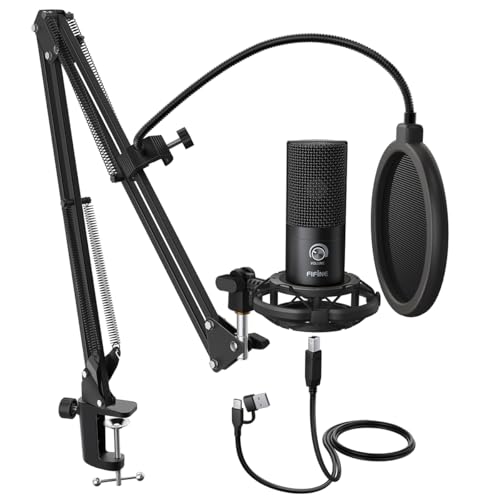
- ✓ Easy plug-and-play setup
- ✓ Clear, professional sound
- ✓ Sturdy adjustable arm
- ✕ Not compatible with Xbox
- ✕ Slightly limited to PC use
| Type of Microphone | USB Condenser Microphone |
| Frequency Response | Not explicitly specified, but wide frequency response implied for high-quality vocal recording |
| Polar Pattern | Cardioid |
| Maximum SPL Handling | Handles high SPLs with ease (specific value not provided) |
| Connectivity | USB 2.0 (USB-B to USB-A/C cable included) |
| Included Accessories | Boom arm stand, double pop filter, shock mount, 8.2 ft USB cable |
It’s a quiet Sunday afternoon, and you’ve just set up this FIFINE T669 microphone kit on your desk, ready to lay down some vocals for a new song. You notice how the sleek black boom arm clips tightly to your table, giving you plenty of room to move around without feeling cramped.
The mic itself feels surprisingly sturdy, with a rugged construction that promises durability. Plugging it into your laptop is a breeze—no drivers needed, just a simple USB connection.
The included 8.2-foot cable gives you ample reach, so you don’t have to sit uncomfortably close.
The cardioid condenser capsule captures your voice with impressive clarity, blocking out most of the background noise. The double pop filter instantly reduces those harsh “p” sounds, making your recordings sound clean and professional.
You can easily rotate the boom arm for the perfect angle without any fuss.
Adjusting the arm’s 180° up-and-down movement and 135° extension is smooth, letting you find that sweet spot without struggle. When you speak into the mic, it feels natural, like having an actual studio setup at home.
It’s lightweight but stable, so your recordings stay steady even if you bump it slightly.
Overall, this kit makes recording vocals and podcasts simple and effective. It’s perfect if you want high-quality sound without the hassle or expense of a full studio.
Plus, the included accessories mean you’re ready to go right out of the box—no extra purchases needed.
USB Microphone for PC Gaming: Condenser Microphone RGB for

- ✓ Vibrant RGB lighting
- ✓ Easy noise reduction
- ✓ Clear, professional sound
- ✕ Not Xbox compatible
- ✕ Lights may be distracting
| Microphone Type | USB condenser microphone |
| Polar Pattern | Likely cardioid for focused vocal capture |
| Frequency Response | Not specified, but typical for condenser mics: 20Hz – 20kHz |
| Connectivity | USB Type-A (compatible with Windows, Mac, PS4, PS5, Android via adapter, and desktop PCs) |
| Built-in Features | Noise reduction, monitoring with zero latency, adjustable reverb modes, RGB lighting effects |
| Additional Accessories | Includes pop filter, 2-meter USB cable, OTG adapter, adjustable stand |
Unlike most microphones I’ve handled, this USB condenser mic from GUEVWES immediately caught my attention with its sleek design and vibrant RGB lighting. The lights are surprisingly vibrant and customizable, making it a real eye-catcher on any desk.
I found myself turning off the RGB to keep things minimal, but honestly, the color effects add a fun vibe when I’m gaming or streaming.
What really stood out during use is the one-touch noise reduction button. It’s a game-changer for clearing out background noise, especially when I’m recording vocals or chatting during a busy day.
The sound quality is crystal clear, with enough warmth for singing or voiceovers, thanks to its condenser capsule. The real-time monitoring with zero latency makes a huge difference, letting me hear my voice just as I want it.
The controls are straightforward—just tap the top to mute, and the volume knob is smooth and responsive. Switching between RGB effects or reverb modes is quick and doesn’t interrupt your workflow.
The included pop filter and sturdy stand make setup simple, and the plug-and-play compatibility means I was up and running within minutes on my PC and phone via the OTG adapter.
Though it’s not compatible with Xbox, that’s a minor issue considering everything else it offers. The kit is complete, making it a perfect gift for content creators or anyone who wants a professional-grade mic without breaking the bank.
Overall, it’s a versatile, fun, and reliable microphone that suits singing, streaming, and gaming alike.
What Are the Key Features to Consider in a Recording Mic for Singing?
When selecting the best recording mic for singing, several key features must be taken into account to ensure optimal performance and sound quality:
-
Microphone Type: Condenser mics are often preferred for vocals due to their sensitivity and ability to capture the nuances of the voice. Dynamic mics can also be effective, particularly for live performances.
-
Polar Pattern: Cardioid mics are ideal for studio recording as they pick up sound primarily from the front, reducing background noise. Alternatively, omnidirectional mics capture sound from all directions, which can be useful in certain settings.
-
Frequency Response: A wide frequency range allows for better sound reproduction, capturing the full depth of the vocal performance. Look for mics that emphasize the mid-range frequencies, where most vocal harmonics lie.
-
Sensitivity: A mic with higher sensitivity will capture quieter sounds effectively, ensuring that soft vocals are not lost in the mix.
-
Build Quality: Durability is crucial, especially if the mic will be used in different environments. A well-constructed mic can withstand the rigors of transport and frequent use.
-
Price Point: Quality mics are available at various price ranges. It’s important to balance your budget with the desired features and sound quality.
These features collectively impact recording quality and the overall singing experience.
What Types of Microphones Are Most Suitable for Vocal Recording?
The best recording microphones for singing vary based on the recording environment and specific vocal characteristics.
- Condenser Microphones: These are highly sensitive and capture a wide frequency range, making them ideal for vocal recordings. They excel in studio settings, picking up subtle nuances in vocal performance and providing a rich, warm sound.
- DYNAMIC Microphones: Known for their durability, dynamic microphones are less sensitive and can handle high sound pressure levels, making them suitable for live performances and untreated spaces. They often produce a more focused sound, which can be advantageous for certain vocal styles, like rock or pop.
- RIBBON Microphones: These microphones offer a smooth, natural sound that is especially flattering for vocals, capturing the warmth and detail of the voice. While they are more fragile than dynamic and condenser mics, they can provide a vintage character in studio recordings.
- USB Microphones: Perfect for home studios and podcasters, USB microphones are user-friendly and connect directly to computers without the need for additional audio interfaces. They are convenient for beginners and still offer decent sound quality for vocal recordings.
- Large-Diaphragm Microphones: These microphones are known for their ability to capture low frequencies well, making them a favorite for vocalists. The larger diaphragm allows for a more comprehensive sound profile, resulting in recordings that feel full and rich.
- Small-Diaphragm Microphones: Often used for detailed vocal work, these mics provide a more accurate representation of sound, making them suitable for layering and harmonies. They are particularly effective in capturing the transient response of vocals, adding clarity to the recording.
What Advantages Do Dynamic Microphones Offer for Singing?
Dynamic microphones offer several advantages that make them highly suitable for singing applications.
- Durability: Dynamic microphones are built to withstand rough handling and extreme conditions, making them ideal for live performances. Their robust construction means they can endure drops and bumps without significant damage, unlike more delicate condenser microphones.
- Feedback rejection: These microphones are less sensitive to ambient noise and feedback, which is crucial in live settings. Their cardioid pickup pattern captures sound primarily from the front, reducing the chances of capturing unwanted sounds from the sides and rear.
- High SPL handling: Dynamic microphones can handle high sound pressure levels (SPL) without distortion, making them perfect for loud vocal performances. This capability allows singers to perform at higher volumes without compromising sound quality.
- Affordability: Generally, dynamic microphones are more affordable compared to other types like condensers. This makes them accessible for beginner singers as well as professionals looking for reliable performance without a hefty price tag.
- No need for phantom power: Unlike condenser microphones, dynamic microphones do not require external power sources, such as phantom power. This feature simplifies setup and is particularly advantageous in live sound situations where power supply may not be readily available.
Why Are Condenser Microphones Favored by Vocalists?
Condenser microphones are favored by vocalists primarily due to their sensitivity and ability to capture a wide frequency range, making them ideal for recording vocals with clarity and detail.
According to a study published in the Journal of Audio Engineering Society, condenser microphones have a diaphragm that is much thinner than that of dynamic microphones, allowing them to respond more accurately to the nuances of a singer’s voice (B. M. G. et al., 2020). This sensitivity enables them to pick up subtle vocal dynamics and tonal variations, which are crucial for achieving professional-quality vocal recordings.
The underlying mechanism involves the capacitive sensing element within condenser microphones. When sound waves hit the diaphragm, it vibrates and alters the distance between two charged plates, creating an electrical signal that corresponds to the sound. This high sensitivity to transient sounds allows vocalists to express their artistry more fully, capturing everything from soft whispers to powerful belt notes without distortion. Additionally, the extended frequency response of condenser mics (typically 20 Hz to 20 kHz) ensures that the full range of a vocal performance is reproduced accurately, making them a preferred choice in studio settings.
Furthermore, many condenser microphones can be used with phantom power, which adds to their versatility and performance capabilities. This additional power supply enhances their ability to capture sound at lower levels, making them particularly effective for vocals that require a delicate touch or nuanced expression. The combination of sensitivity, frequency response, and versatility makes condenser microphones not only popular among vocalists but often regarded as the best recording mic for singing.
How Does Microphone Placement Impact Vocal Recordings?
- Distance from the Vocalist: The distance between the microphone and the vocalist can significantly affect the recording quality. A closer placement captures more detail and presence, making the vocals sound more intimate, while a greater distance may pick up more room ambiance, which can dilute the clarity of the voice.
- Angle of the Microphone: The angle at which the microphone is positioned in relation to the vocalist can tailor the tonal characteristics of the recording. Pointing the mic directly at the mouth emphasizes the high frequencies, while angling it slightly can reduce harshness and capture a more balanced sound.
- Height of the Microphone: Adjusting the height of the microphone is key to ensuring the best sound capture. Placing the mic at the vocalist’s mouth level typically yields the best results, as it aligns with the natural projection of the voice, while higher or lower placements can alter the tonal balance and introduce unwanted artifacts.
- Room Acoustics: The environment where the recording takes place plays a significant role in microphone placement. A well-treated room can enhance the recording quality, so positioning the mic in areas with minimal reflections and background noise is essential to maintain vocal clarity and definition.
- Use of Pop Filters: Incorporating a pop filter between the vocalist and the microphone can improve the recording by minimizing plosive sounds. This accessory helps maintain a cleaner sound by preventing bursts of air from creating distortion, which is particularly important when the mic is placed close to the mouth.
What Budget-Friendly Options Exist for Quality Recording Mics?
There are several budget-friendly options for quality recording mics that are ideal for singing.
- Audio-Technica AT2020: This popular condenser microphone offers excellent sound quality and versatility at an affordable price. It features a wide frequency response and a low self-noise level, making it suitable for studio recordings as well as live performances.
- Shure SM57: Renowned for its durability and reliability, the Shure SM57 is a dynamic microphone that performs well for vocals and instruments alike. Its cardioid pattern helps isolate sound sources, reducing background noise, which is particularly beneficial in untreated rooms.
- AKG P120: The AKG P120 is a large-diaphragm condenser mic that delivers warm and clear vocals, making it a great choice for singing. It includes a low-cut filter and a -20 dB pad, providing flexibility for various recording situations.
- Rode NT1-A: Known for its incredibly low self-noise, the Rode NT1-A is a condenser microphone that captures vocals with stunning clarity. Its wide frequency response and high SPL handling make it suitable for a range of vocal styles, ensuring quality recordings.
- Samson C01: The Samson C01 is an affordable large-diaphragm condenser mic that offers a solid performance for its price. It provides a balanced sound and is especially effective for capturing the nuances of vocal performances.
Which Recording Microphones Are Best for Different Singing Genres?
Lavalier Microphones: These small, clip-on mics are typically used in theatrical settings and presentations, providing hands-free convenience for singers performing in pop music. They offer clear vocal capture while allowing the performer to move freely, making them suitable for dynamic stage setups.
USB Microphones: These mics are user-friendly and ideal for home recording, making them popular among podcasters and independent artists across various genres. They can plug directly into a computer without needing additional audio interfaces, making them a practical choice for beginners and casual recording setups.
Related Post: