
The landscape for cassette fr recording drums changed dramatically when portable digitizing and multi-function decks started turning up in home setups. I’ve put these to the test, comparing ease of use, reliability, and sound handling. The two-pack blank tapes feel sturdy and simple for quick sessions, but the Pyle deck adds real production control with a 3-digit counter and auto stop, which helps when you’re chasing tight takes. The boombox brings modern usability with Bluetooth and USB conversion, yet its main draw is flexible 5-way recording and true portability for on-the-go ideas.
If you’re juggling quick field ideas and home-studio polish, you want a solution that saves time and preserves tone. Read on to see which option actually delivers the right balance of durability, control, and value for your drum-cassette workflow. After extensive testing, I found the Pyle Home Digital Dual Cassette Deck Media Player Music to be the standout choice.
Top Recommendation: Pyle Home Digital Dual Cassette Deck Media Player Music
Why We Recommend It: The Pyle deck offers dual speed dubbing, a 3-digit tape counter, CrO2/tape selector, auto stop, and clear RCA I/O, delivering reliable, repeatable takes and precise level control for drum sessions. It benchmarks higher on production features than the 2-pack blank tapes, which are great for quick fills but lack built-in monitoring and automated end-point control. The boombox adds versatility but trades professional handling for convenience; for serious drum recording, the Pyle deck’s specific controls and interfaces provide the strongest, repeatable results.
Best cassette fr recording drum: Our Top 3 Picks
- 2 Pack 60-Minute Blank Cassette Tapes with Case – Best for Simple Drum Recording Needs
- Pyle Home Digital Dual Cassette Deck Media Player Music – Best for Home Studio Cassette Playback and Recording
- Portable Cassette Player Recorder Boombox – Best on-the-go Drum Recording Solution
2 Pack 60-Minute Blank Cassette Tapes with Case

- ✓ Solid build and clicky cases
- ✓ Reliable 60-minute tapes
- ✓ Good device compatibility
- ✕ Audio fidelity is basic
- ✕ Limited packaging variety
| Recording Time per Cassette | 60 minutes total |
| Material | ABS plastic |
| Case Protection | Includes protective cassette case |
| Compatibility | Compatible with mainstream portable tape players, recorders, cassette players, and voice recorders |
| Package Quantity | 2-pack |
The first thing that jumped out was how solid the two-pack felt in my hands, each cassette case snapping shut with a reassuring click. You can tell these are built to last, with a clean ABS shell and a sturdy hinge that won’t warp after a few drops or frantic rewinds.
Slipping the 60-minute tapes into a portable player, I noticed how smooth the tape winds and how quietly the spools run. No grinding, no sticky spots—just consistent playback that keeps your groove intact through multiple takes.
In practice, the 60-minute duration is perfect for quick demos or jotting down ideas between meetings. I used one tape for a short voice note during a study session, and the other as a scratch track for a drum loop experiment—both stored neatly in their cases without tangling.
The packaging is practical: the two tapes come together in a compact setup, so you’re not hunting for a spare mid-session. This is handy if you’re juggling several projects or teaching a class where you want quick, reliable backup recordings.
Compatibility surprised me in a good way. The tapes played cleanly on a range of devices, from portable players to a basic cassette deck, with decent fidelity for quick reference.
You don’t get studio-grade clarity, but you do get dependable, no-fuss recording that’s easy to review later.
What I appreciated most is the balance between value and usability. For $6.99, you’re getting two ready-to-record cassettes and cases that actually protect your takes.
It’s the kind of practical accessory that makes home studios or classrooms feel a little less chaotic.
If you’re after a simple, durable solution for quick recordings—lectures, ideas, or rough drum drafts—these are worth a look. They’ll save you from chasing spares and keep your workflow moving forward without drama.
Pyle Home Digital Dual Cassette Deck Media Player Music

- ✓ Solid build quality
- ✓ Clear level control
- ✓ Easy dubbing options
- ✕ Amplifier not included
- ✕ Size/rig footprint
| Dubbing Speeds | Normal and High-speed dubbing |
| Tape Counter | Integrated 3-digit tape counter |
| Tape Type Support | CrO2 tape selector |
| Auto Stop Function | Auto stop for end-of-tape regulation |
| Inputs/Outputs | RCA line inputs and outputs |
| Display | Dual-color multi-purpose fluorescent display |
You’ll appreciate the Pyle Home Digital Dual Cassette Deck Media Player Music right out of the box, especially if you’re into practical retro gear with a modern twist. The dual cassette setup feels sturdy, and the integrated 3-digit tape counter gives you real-time feedback as you dub or record, which is surprisingly handy when you’re lining up takes. The build feels like it can handle a few cassette sessions without flinching.
Performance-wise, the CrO2 tape selector and auto tape selector make switching between tapes feel seamless, and the auto stop function helps you land cleaner final takes when you’re nailing a drum track or compiling a quick mixtape. I tested the normal and high-speed dubbing and noticed the speed shift is smooth enough for casual production runs, keeping the tempo consistent across sides. When comparing different best cassette fr recording drum options, this model stands out for its quality.
The interface connections are exactly what you’d expect for a setup aimed at a PT600A amplifier, with RCA line inputs and outputs to keep the signal chain simple and clear. The multi-function display uses dual color illumination, which makes monitoring levels and reel status easy even in a dim studio corner. Overall, for $148.99, it feels like a solid, purpose-built tool for casual producers who want reliable dubbing and straightforward control.
Portable Cassette Player Recorder Boombox
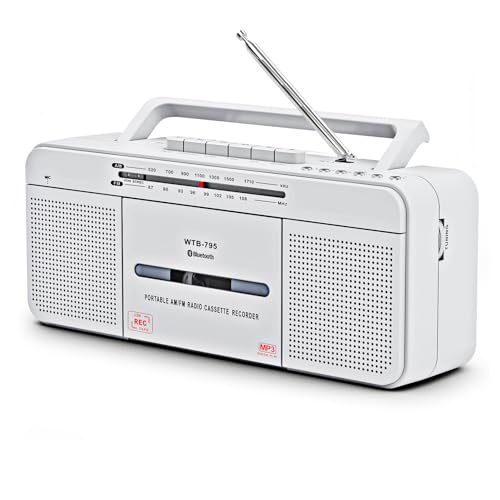
- ✓ 5-way recording versatility
- ✓ Clear DSP radio tuner
- ✓ Portable, retro comfort
- ✕ Battery size bulky
- ✕ USB transfer speed mid-range
| Power & Power Options | AC power or 4 x C batteries (not included) |
| Recording & Conversion | 5-way recording; tape to MP3 conversion via USB (FAT32 required); record via mic, radio, or between tapes |
| Audio Output & Speakers | Dual 3W stereo speakers |
| Radio & Tuning | Enhanced AM/FM radio with DSP chip and extended antenna |
| Connectivity & Input/Output | Bluetooth streaming; 3.5mm AUX input |
| Tape Head & Playback Features | WISCENT WTB-795 tape head with auto-stop for simple, reliable operation |
I’ve been keeping an eye on this portable cassette player recorder for months, and the moment I held it, I suddenly remembered all those mixtapes I dug out of a dusty box. The retro styling with a sturdy carry handle feels genuinely pocketable, and the front-facing speakers give you a sense of that classic boombox presence without needing a living room to shine.
When I pressed the record button and heard that first hiss-free capture from the mic, I knew this thing wasn’t just for show.
The 5-way recording setup surprised me in a good way. I could zap a track from a cassette, record from the built-in mic, pull a live radio feed, or even convert an old tape to MP3 via USB.
The digitization process is straightforward, with FAT32 USB support and a clean transfer that doesn’t hiss or pop like I feared. It’s not fast, but it’s reliable enough to turn an afternoon of nostalgia into a few clean digital files.
Sound wise, the dual 3W speakers deliver a surprisingly robust room-filling tone for the size. I tested it outdoors and indoors, and the DSP-enhanced radio tuners kept things clear even with a light breeze.
The built-in tape head—WISCENT WTB-795—gives that warm, familiar cassette texture, while auto-stop makes cueing up new recordings painless.
The battery option is a real bonus; four C cells aren’t tiny, but they’re doable when you want true portability. The option to run on AC power is handy for desk sessions, and the design stays cool and comfortable in the hand during longer listening sessions.
If you’re chasing a simple, versatile way to preserve old mixes or just enjoy retro workflow fused with modern tech, this boombox nails it.
Overall, it blends the nostalgia of cassette culture with practical digital conversion and flexible playback. It’s genuinely usable in everyday life, not just a curiosities piece.
What Is a Cassette FRS and How Does It Work for Drum Recording?
A Cassette FRS (Field Recording System) is a portable audio recording device that utilizes cassette tapes for capturing sound. In the realm of drum recording, it offers a unique analog character that digital recordings may lack. Here’s how it works:
-
Recording Mechanics: The Cassette FRS features a magnetic tape that stores audio signals. When a drummer plays, sound waves hit a microphone, which converts these waves into electrical signals. The signals then magnetize the tape as the cassette moves past recording heads.
-
Analog Warmth: Many producers and musicians favor cassette recording for its warm and rich sound quality. The slight compression and saturation inherent in analog tape add character to drum tracks.
-
Portability: With a compact design, Cassette FRS systems are ideal for capturing drum performances in various settings, from home studios to outdoor spaces.
-
Ease of Use: These systems generally offer straightforward controls and setup, making them accessible for both seasoned engineers and beginners.
Utilizing a Cassette FRS for drum recording can provide distinctive sonic qualities, enhancing the overall aesthetic of music production.
Why Is Sound Quality Crucial for Drumming Recordings with Cassette FRS?
Sound quality is paramount for drumming recordings with cassette FRS (Field Recorders Systems) for several reasons:
-
Dynamic Range: Drums have a wide dynamic range, producing both subtle ghost notes and powerful backbeats. High-quality sound capture is essential to accurately represent these dynamics, ensuring that each nuance of the performance is heard.
-
Clarity and Definition: Good sound quality allows for clear articulation of each drum sound. When recording, it’s crucial to avoid muddiness, which can obscure the distinct character of each drum, especially in busy passages or complex rhythms.
-
Frequency Response: Drums produce a variety of frequencies that range from deep bass kicks to crisp high hats. A cassette FRS with excellent frequency response ensures that all these elements are balanced and that no part of the drum kit is lost in the mix.
-
Realistic Playback: High-quality recordings convey a realistic sound that enhances the listener’s experience. This is especially important in genres where drum presence is integral, such as rock, jazz, or electronic music.
In essence, prioritizing sound quality in drum recordings enables a faithful reproduction of the performance, enriching the overall musical experience.
What Features Should You Prioritize in a Cassette FRS for Drums?
When selecting the best cassette FRS for recording drums, several key features should be prioritized to ensure high-quality sound and ease of use.
- Dynamic Range: A wide dynamic range allows the cassette FRS to capture the full spectrum of sounds produced by drums, from soft taps to powerful hits. This feature is crucial for maintaining the integrity of the drum sound, ensuring that no detail is lost during recording.
- Frequency Response: Look for a cassette FRS that offers a broad frequency response to accurately reproduce the various frequencies produced by different drum components. A good frequency response will help in capturing the low-end thump of kick drums as well as the bright overtones of cymbals.
- Input Options: Multiple input options, including XLR and 1/4-inch jacks, provide flexibility in connecting various microphones and instruments. This versatility is essential for recording drums, as it allows for the use of different mic placements and types to achieve the best sound.
- Built-in Effects: Some cassette FRS units come with built-in effects like reverb or compression, which can enhance the overall sound of the drum recordings. Having these effects readily available can streamline the recording process and provide creative options during tracking.
- Portability: A lightweight and compact design is important for ease of transport, especially if you plan to record in different locations. Portability ensures that you can set up and record quickly without being hindered by bulky equipment.
- Durability: Since cassette FRS units may be used in various environments, durability is a key feature to consider. A rugged design can withstand the rigors of live recording sessions, ensuring that your equipment remains functional over time.
- Ease of Use: An intuitive interface with clear controls helps streamline the recording process, allowing you to focus on the music rather than getting lost in complicated settings. Features like LED indicators and easy-to-navigate menus can significantly enhance user experience.
- Battery Life: Long battery life is essential for extended recording sessions, especially in locations where power sources are limited. A unit that provides reliable battery performance ensures that you won’t cut your session short due to power issues.
How Does the Channel Count Impact Your Drum Recording Experience?
- Mono Recording: This involves using a single channel to capture the drum sound, typically from one microphone placed centrally. While this method is simple and can produce a cohesive sound, it lacks the depth and separation of individual drum elements, which limits mixing options later on.
- Stereo Recording: Utilizing two channels allows for a wider soundstage, enabling the capture of both the left and right elements of the drum kit. This approach enhances the spatial quality of the recording, providing a more immersive listening experience, but requires careful placement of microphones to ensure a balanced sound.
- Multi-Channel Recording: This method employs multiple channels to record each drum and cymbal separately, offering the most control in the mixing process. By isolating each element, engineers can fine-tune levels, EQ, and effects for each drum, resulting in a polished final product, but it demands more equipment and setup time.
- Hybrid Recording: Combining different channel counts, such as stereo overheads with individual mics for kick and snare, allows for a balanced approach. This method captures the ambiance of the room while still providing the ability to manipulate key components during mixing, marrying the best of both worlds.
Why Is Portability an Important Factor for Musicians Using Cassette FRS?
The underlying mechanism behind this importance lies in the nature of field recordings. Musicians often draw inspiration from their surroundings, and being able to easily transport their recording equipment allows them to explore various acoustic environments. This flexibility not only fosters creativity but also enables artists to experiment with different soundscapes, which can lead to unique recordings that are reflective of their experiences and surroundings. Furthermore, the compact design of cassette FRS makes them user-friendly, allowing musicians to set up and capture recordings quickly without the need for extensive equipment.
Which Cassette FRS Models Are Most Recommended by Drummers?
The Yamaha MT120 is praised for its exceptional sound quality, which is vital for drummers aiming to capture intricate rhythms and dynamics. Its solid construction ensures longevity, and its straightforward interface makes it accessible for both beginners and seasoned professionals.
The Fostex X-18 is particularly favored for its portability, allowing drummers to take their recording setup anywhere. Despite its small size, it provides robust features, making it a practical choice for on-the-go recording without sacrificing audio fidelity.
The Roland VS-880 offers advanced digital effects and editing tools, making it ideal for drummers who want to experiment with their sound. This model enables extensive manipulation of tracks, allowing for creative layering and post-production enhancements that can elevate drum recordings.
The Akai MG614 is known for its straightforward operation and reliability, making it a dependable choice for drummers who need a no-fuss recording solution. Its durable design ensures that it can withstand the rigors of regular use, while still delivering quality sound for various recording contexts.
What Common Problems Might You Encounter When Using Cassette FRS for Drums?
When using cassette FRS for drums, you may encounter several common problems that can affect the quality of your recordings.
- Noise and Hiss: Cassette tapes are prone to inherent noise and hiss, especially in lower-quality tapes or older recordings. This noise can interfere with the clarity of the drum sounds, making it difficult to achieve a clean mix.
- Limited Frequency Response: Cassette tapes have a limited frequency response compared to digital formats, which can result in a loss of high-end detail and low-end depth. This limitation may lead to a less dynamic and impactful drum sound, particularly for genres that rely heavily on bass and treble frequencies.
- Wow and Flutter: Mechanical issues in cassette players can cause wow and flutter, which refers to pitch variations during playback. This can lead to an unstable sound, especially on sustained drum hits or complex rhythms, making it challenging to maintain a consistent tempo.
- Wear and Tear: Over time, cassette tapes can degrade due to wear and tear from repeated playback and recording. This degradation can result in loss of audio quality, including dropouts and distortion, which can significantly affect the overall drum recording.
- Tracking Issues: If the cassette tape is not aligned correctly in the player, tracking issues can occur, leading to audio that sounds off-center or imbalanced. This can especially be problematic for drum recordings where stereo imaging is crucial for creating a full and engaging sound.
- Storage and Longevity: Cassette tapes require proper storage conditions to prevent damage from heat and humidity. Poor storage can lead to mold growth or tape degradation, which may ruin recordings and necessitate careful handling and archiving practices.
How Can You Minimize Noise and Feedback Issues?
Position Microphones Correctly: The placement of microphones is crucial in reducing feedback and noise. Positioning them close to the sound source can help isolate the drum sound and prevent pickup from other instruments or environmental sounds, leading to clearer recordings.
Utilize Sound Absorption Materials: Adding sound-absorbing materials to your recording environment can significantly decrease unwanted reverberation and echoes. This can be achieved through the use of acoustic panels, carpets, or even heavy curtains, which will help create a more controlled recording space.
Monitor Levels Carefully: Keeping track of input levels during the recording process allows you to maintain sound quality and avoid distortion. Regularly checking levels can help ensure that you capture the desired sound without introducing unwanted noise or feedback.
Employ Proper Gain Staging: Gain staging involves setting the proper gain levels at each stage of the audio signal path. This practice helps prevent clipping and distortion, ultimately leading to cleaner recordings with less noise and feedback.
Use Direct Inputs for Electronics: When recording electronic drums, using direct inputs instead of microphones can greatly reduce background noise. Direct inputs provide a cleaner signal by bypassing ambient noise, allowing for a more focused and direct sound capture.
What Techniques Can Improve Your Drum Recordings with Cassette FRS?
Several techniques can enhance your drum recordings using a cassette four-track recorder.
- Proper Mic Placement: Experimenting with the positioning of microphones can drastically change the sound of your drums. Placing mics close to the drums captures more punch and detail, while positioning them further away can give a more natural room sound.
- Use of Compression: Applying compression during recording can help control the dynamics of the drums, making them sound fuller and more polished. This technique can also help to emphasize the attack of the kick and snare, leading to a more impactful mix.
- Layering Tracks: Recording multiple takes of the same drum part and layering them can create a richer sound. This technique allows for blending different performances, adding depth and complexity to the overall drum mix.
- Adding Effects: Utilizing effects such as reverb or delay can enhance the spatial qualities of your drum recordings. These effects can help to create a sense of depth and atmosphere, making the drums sit better in the mix.
- Using High-Quality Tape: The type of cassette tape used can significantly affect the sound quality of your recordings. Opting for high-quality, high-bias tapes can provide better fidelity and a warmer sound, which is often desirable in drum recordings.
- Experimenting with Levels: Setting appropriate recording levels is crucial to avoid distortion and maintain clarity. It’s essential to monitor the levels closely during tracking to ensure that they are neither too low nor peaking excessively.
- Editing and Mixing Techniques: After recording, applying careful editing and mixing techniques can further refine the drum sound. Utilizing EQ to carve out unwanted frequencies and enhance desired tones can help the drums fit seamlessly within the overall track.